


Florida BDI Election: Deadline, Eligibility, and Eight-Election Limit
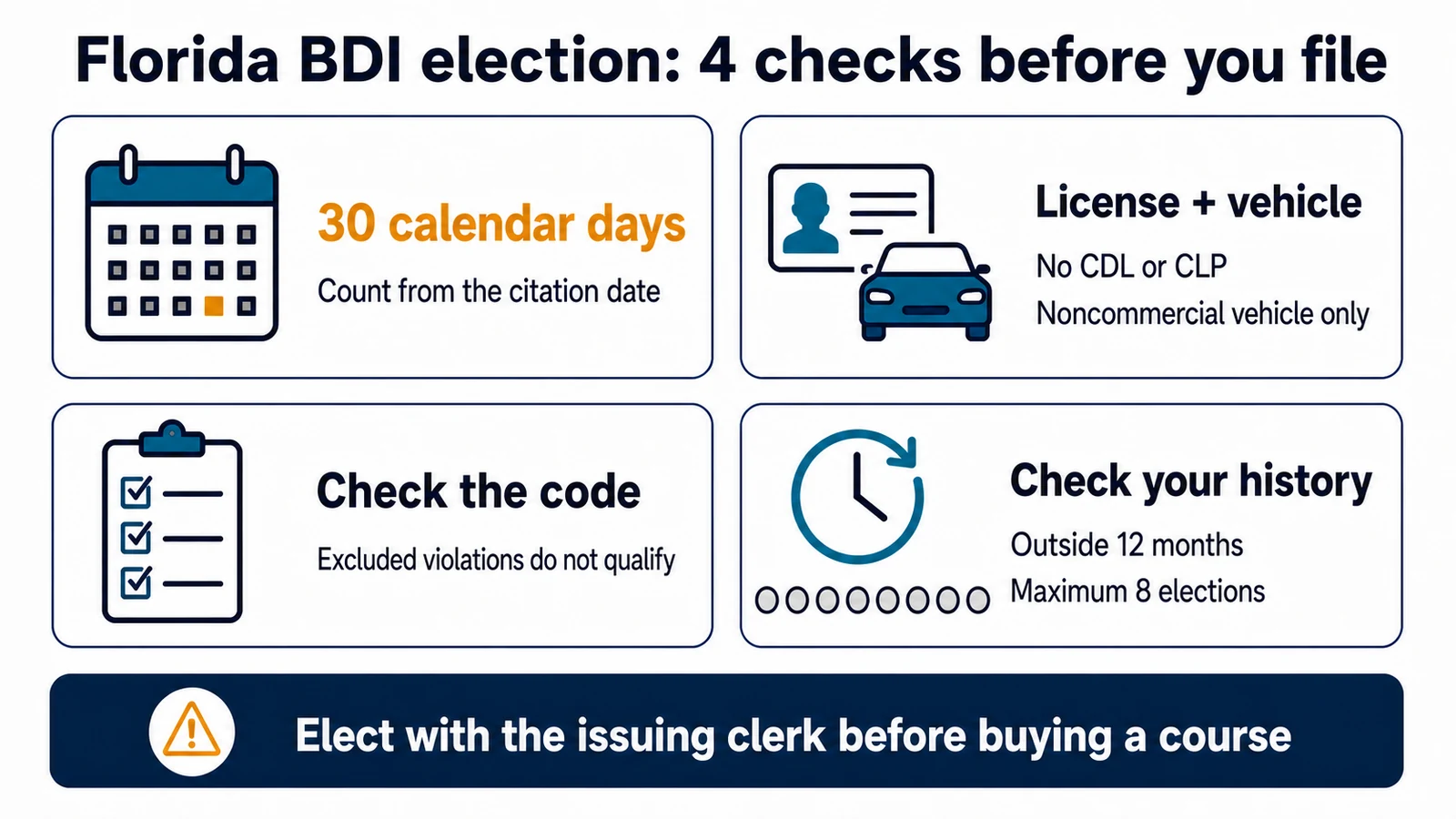
A Florida BDI election is a formal choice you make through the clerk of court—not a course you buy first and explain later. For an eligible noncriminal traffic citation, you generally have 30 calendar days after the citation date to choose Basic Driver Improvement instead of the ordinary payment or hearing path.
Before filing, check three separate limits: the type of license and vehicle involved, the exact violation code, and your prior election history. Florida currently allows no election if you made one in the preceding 12 months and no more than eight elections in a lifetime.
Quick answer: Use the issue date printed on the citation, count 30 calendar days, and contact the clerk in the county that issued it before that response period expires. Ask the clerk to confirm your eligibility and election count, file the required election or affidavit, pay the clerk's stated amount, and save written confirmation. Enrolling in a course alone does not preserve the option.
Rules verified: September 1, 2026, against the 2026 Florida Statutes and the current FLHSMV Uniform Traffic Citation.
General information only: This page explains Florida's statewide elective BDI framework. It is not legal advice. The clerk handling the citation controls the case record, accepted filing methods, required payment, and completion deadline.
What Counts as a Florida BDI Election?
Florida Statutes section 318.14(9) lets a qualifying driver elect a department-approved Basic Driver Improvement course in lieu of a court appearance for an eligible infraction. The election is the clerk-facing case choice. Course registration and course completion happen after that choice has been accepted.
These actions are not interchangeable:
- Paying the citation normally means you admit the infraction and waive a hearing on whether you committed it under section 318.14(4)(b). Points may be assessed when applicable.
- Requesting a hearing asks the court to decide the case or address the disposition.
- Electing BDI means you plead no contest and adjudication is withheld.
- Buying a BDI course only creates a relationship with a course provider; it does not prove that the clerk accepted an election.
Section 318.14(4)(b) says payment means the driver has “admitted the infraction” and “waived his or her right to a hearing.”
A valid election followed by compliance produces a specific statewide result: adjudication is withheld, points are not assessed for that citation, and the civil penalty imposed under section 318.18(3) is reduced by 18%. It does not erase the citation or remove unrelated points already on your record.
The broader course process belongs in the companion Florida Basic Driver Improvement Course: 30-Day Election Guide, which should be linked here only after that page is published.
Calculate the 30-Day Florida BDI Election Deadline
Section 318.14(4)(a) requires a response “within 30 days after the date of issuance of the citation.” The current FLHSMV Uniform Traffic Citation likewise says to act “within 30 calendar days.”
The citation also warns: “your driving privilege will be suspended until you comply” if you miss that response requirement. Contact the clerk immediately if the deadline has passed rather than assuming a course purchase cures the failure.
Start with the printed citation date
Do not begin the count from:
- the day you found the ticket in the car;
- the date you opened a mailed reminder;
- the day the citation appeared in an online portal;
- the day you chose a course; or
- the day you planned to pay.
Use the citation issue date printed on the ticket unless the clerk gives you a different controlling instruction in writing.
For example, if a citation is issued on September 4, the date 30 calendar days later is October 4. Weekends and holidays can affect availability. Confirm the clerk's receipt rule and file early enough for acceptance.
Build a deadline record
Write down the dates instead of trusting memory:
- Citation number: __________
- Citation issue date: __________
- Issuing county: __________
- Date 30 calendar days later: __________
- Clerk's filing method: online / mail / in person / other
- Election submitted: __________
- Election accepted: __________
- Receipt or confirmation number: __________
- Course-completion deadline: __________
- Proof deadline and method: __________
If you file by mail, ask whether the clerk uses the postmark date or the date received. If you file online, save the confirmation page and payment receipt. A draft form, an unprocessed cart, or an unanswered message is not proof that the case was updated.
Check Driver and Vehicle Eligibility
The elective BDI path is not available to every licensed driver who receives a ticket.
CDL and CLP holders are excluded
You cannot make this election if you held a commercial driver license or commercial learner's permit. The restriction is based on holding the credential; it is not limited to a ticket received while working.
That means a CDL holder cited in a personal car should not assume the noncommercial car makes the election available.
The cited vehicle must be noncommercial
The statute also requires the citation to have been received while driving a noncommercial motor vehicle. A driver with a regular license should not assume that alone resolves the issue if the cited vehicle was commercial.
These are separate tests:
- Did you hold a CDL or CLP?
- Were you driving a commercial motor vehicle?
If either answer may be yes, give the clerk the license class, vehicle information, and exact citation before paying or enrolling.
Check the Exact Violation Code
Everyday descriptions such as “speeding,” “license ticket,” or “registration problem” are too broad to determine eligibility.
Section 318.14(9) prints the exclusions by code. Match the number on the citation against this list:
- Sections 316.183(2), 316.187, and 316.189: excluded when the driver exceeded the posted limit by 30 mph or more;
- Section 320.0605;
- Section 320.07(3)(a) and (b);
- Section 322.065;
- Section 322.15(1);
- Section 322.61; and
- Section 322.62.
The statute numbers matter more than a broad label such as “registration ticket.” Ask the clerk to interpret the exact citation rather than guessing what a code covers.
Use this screening process:
- Find the statute and subsection printed on the citation.
- Confirm whether the citation says a court appearance is required.
- Compare the exact code with the current section 318.14(9) exclusions.
- Ask the issuing county clerk to confirm the result in the case system.
Do not rely on a provider's checkout questionnaire as the final eligibility decision. A provider cannot change the charge or waive a statutory exclusion.
Required appearances and criminal charges
The elective provision applies in lieu of a court appearance for an eligible noncriminal infraction. If the citation marks a criminal violation or mandatory court appearance, follow that instruction and contact the clerk promptly.
Completing a voluntary course does not cancel an appearance requirement. If the charge, crash facts, or court notice creates uncertainty, consider speaking with a qualified Florida traffic attorney before choosing a plea or disposition.
Section 318.14(10)(a) creates a separate no-contest and proof-of-compliance path for certain document-related offenses, with its own three-election lifetime limit. The Florida Court Clerks & Comptrollers overview describes that route. It is not the elective BDI path or its eight-election count.
Apply the Preceding 12-Month Rule
Florida law says you may not make a section 318.14(9) election if you made one in the preceding 12 months. The current citation summarizes the combined cap: “one such election per 12 month period” and no more than eight in a lifetime.
This is a rolling lookback, not a once-per-calendar-year allowance. January of a new year does not automatically reset eligibility after an election made the previous summer.
The relevant event is the prior election. Do not calculate only from:
- the prior citation date;
- the date you registered for the earlier course;
- the course completion date;
- the certificate date; or
- the date points were or were not posted.
If your earlier election was close to the 12-month boundary, do not self-approve based on a rough date. Ask the clerk to check the election date recorded by FLHSMV and confirm that the new election is allowed.
A safe date example
Suppose the record shows a prior election on October 18, 2025 and the new citation was issued on October 10, 2026. The new citation arrived before 12 months had passed, even though its 30-day response window extends beyond October 18.
Do not assume waiting until a later day in the response window makes you eligible. The public statute does not answer every timing edge case in consumer-facing language. Give both dates to the issuing clerk and ask whether the clerk can accept the election for this citation before you sign an eligibility affidavit.
Apply the Eight-Election Lifetime Limit
The current 2026 statute allows no more than eight elections in a lifetime under section 318.14(9).
This is a lifetime count, not eight courses during a license-renewal period or eight point-prevention outcomes that remain visible on a short driving record. Old elections can matter even when you no longer have certificates or remember the counties involved.
Why some pages still say five
Florida previously used a five-election lifetime limit. Some official-looking handbooks, clerk forms, and local pages still repeat that older number.
The current 2026 Florida Statutes, the current Uniform Traffic Citation revised May 2025, and the Volusia County Clerk's current election instructions say eight. If another clerk page or form says five, do not alter the form yourself or submit a statement you believe is inaccurate. Contact that clerk, point to the current version of section 318.14(9), and ask which current form or procedure to use.
Does the eighth election remain available?
The statute says a person may not make more than eight elections. In ordinary counting, that means a person with seven recorded elections may still have an eighth available if every other requirement is met; a person with eight has reached the cap.
The clerk's record controls the practical decision. Confirm the count before filing, especially if you remember a withdrawn, incomplete, or late course from years ago. Whether that event remains recorded as an election is not something a new provider should guess.
How to Verify Your Prior Election History
Start with the issuing county clerk. Ask the clerk to confirm:
- whether the system shows you as currently eligible;
- the number of prior section 318.14(9) elections;
- the recorded date of the most recent election; and
- whether an old incomplete or disputed case is included.
Ask the clerk what the current driver record shows about your eligibility, election count, and most recent election date. An older FLHSMV driver-record training document identifies a Special Driver Information area, but its age and record illustration should not control a 2026 eligibility decision.
Provide enough identifying information for the clerk to locate the correct person. Keep your own log with the county, election date, completion date, and confirmation for every election.
Make the Election Through the Correct Clerk
Contact the clerk of court in the county where the citation was issued. Use the contact information on the ticket or that clerk's official website.
Ask for the current BDI election instructions and complete every required part. Depending on the county, that may include:
- an online election;
- a signed affidavit;
- a no-contest plea;
- the citation or citation number;
- the clerk's election payment; and
- confirmation of driver and violation eligibility.
Read any affidavit carefully. You may be attesting that you meet every time, license, vehicle, and violation requirement. Do not sign based on an old page or a guess.
Ask these questions before submitting
- What is the last date and time you will accept this election?
- Does my exact violation qualify under current section 318.14(9)?
- What election count and last-election date appear in the record?
- What form and amount are required?
- How will I know the election was accepted?
- How long do I have to complete the approved BDI course?
- Does the provider report completion, must I send proof, or must both happen?
- How do I confirm the case is satisfied afterward?
County completion periods and their trigger events are not uniform. The Volusia County Clerk says, “sixty (60) days from the date the affidavit is filed.” The Miami-Dade Clerk publishes 120 days from payment or court appearance. Treat the issuing clerk's deadline as separate from the statewide election window.
Know when provider reporting should occur
Section 318.1451 requires a provider to report completion to FLHSMV through the Driver Improvement Certificate Issuance System within five days. After receiving the unique certificate number, the provider has three days to submit the completion information and citation number to the issuing county clerk through the Florida Courts E-Filing Portal.
Those reporting clocks do not replace the clerk's proof instructions. Keep your certificate and ask the clerk when to follow up if the case has not updated after the provider's reporting period.
Handle Common Edge Cases Without Guessing
You are on day 29 or day 30
Contact the clerk immediately through an accepted same-day channel. Do not spend the remaining time comparing providers. Confirm the clerk's cutoff time and save proof of acceptance.
You already passed day 30
Contact the issuing clerk immediately. Late fees or a license-related consequence may already be in motion. Florida's public statewide materials do not promise a late-election remedy, so do not buy a course assuming the clerk will reopen the option.
You have more than one citation
Ask the clerk whether each citation is independently eligible, whether each needs a separate election and payment, and how the elections will be counted. Do not assume one course or one affidavit resolves every citation from the same stop.
Your prior election was not completed
Ask whether the prior event remains recorded as an election and whether the old case must be satisfied first. The statutory limit refers to making an election; an unfinished course should not be treated as though the election never happened without clerk confirmation.
You requested a hearing and changed your mind
Do not withdraw the hearing or pay the citation until the clerk confirms that an election remains available and explains the required procedure. A pending hearing does not authorize a provider to change the case disposition.
Mistakes That Can Cost the Election
Treating 30 days as the course deadline
The 30-day period is the statewide citation-response window. The clerk supplies a separate course-completion and proof schedule.
Using a calendar-year reset
The restriction looks back over the preceding 12 months. New Year's Day does not erase an election from the previous year.
Trusting a five-election page
Five is an older statewide limit. Current law says eight, but a stale local form should be resolved with the clerk before you certify eligibility.
Calling withheld adjudication a dismissal
A valid election prevents points for the qualifying citation and withholds adjudication. It does not make the citation vanish or subtract points from older violations.
Frequently Asked Questions
How long do I have to elect BDI in Florida?
The current statewide citation-response period is 30 calendar days after the citation date. File through the issuing county clerk and confirm receipt; do not merely enroll in a course during that period.
Can I elect Florida traffic school twice in one year?
Not if the second election falls within the preceding 12 months. This is a rolling period, not a calendar-year rule. Ask the clerk to confirm the recorded date of your last election.
Is Florida's lifetime traffic-school limit five or eight?
It is eight under the current 2026 version of section 318.14(9). Pages and forms that still say five are using an older limit.
Does taking a mandatory course count as a BDI election?
The eight-use rule applies to elections under section 318.14(9). Court-ordered or FLHSMV-required attendance is a different path. Because a record may contain several course types, ask the clerk which entries count as elections.
Can a CDL holder elect BDI after a ticket in a personal car?
No under current section 318.14(9). A person who holds a CDL or CLP is excluded even when the cited vehicle is personal and noncommercial.
Can I elect BDI for speeding 30 mph over the limit?
The election statute excludes covered speeding violations at 30 mph or more over the posted limit. Use the exact statute number on the citation and ask the clerk whether a hearing or another procedure applies.
When do I have to finish the course?
Use the completion deadline given by the issuing county clerk. County procedures vary, so the 30-day election deadline should not be reused as a universal course deadline.
The Bottom Line
Treat a Florida BDI election as a time-sensitive court filing. Count 30 calendar days from the citation date, then have the issuing county clerk confirm the violation, license, vehicle, prior-election date, and lifetime count before you certify eligibility.
The current limits are one election outside the preceding 12 months and no more than eight in a lifetime. Preserve written proof of the election, record the separate completion deadline, and use an FLHSMV-approved BDI course only after the clerk accepts the choice.
Related Reading
- Traffic School vs. Court: How to Choose
- How Driver License Points Work
- Traffic School Rules by State
- Is Online Traffic School Legit?
- How to Avoid Points on Your License
Sources
- Florida Legislature — Fla. Stat. § 318.14, noncriminal traffic-infraction procedures
- FLHSMV — Uniform Traffic Citation, HSMV 75901 revised May 2025
- Florida Legislature — Fla. Stat. § 318.1451, driver-improvement schools and reporting
- FLHSMV — Reading a Florida Driver Record
- Florida Court Clerks & Comptrollers — Traffic-ticket response options
- Volusia County Clerk — Civil traffic and school-election instructions
- Miami-Dade Clerk — Traffic school
Last updated: September 1, 2026.