

Texas Driving Safety Course: Ticket Dismissal and Court Steps

A Texas driving safety course may lead to dismissal of an eligible traffic charge, but the course is only one part of the process. The court named on your citation must receive a valid request, and buying a class does not make that request for you.
The safest sequence is court first, course second, proof last. You generally must ask on or before the answer date on the notice to appear, enter a guilty or no-contest plea for this procedure, provide proof of financial responsibility, and follow the court’s payment and document instructions. After the court grants the request, Texas law allows 90 days to complete an approved course and present the required evidence.
Quick answer: Contact the court on the citation before the answer date. Confirm that you and every charge you want dismissed qualify, submit the court’s request and required documents, pay the court amount, then complete a TDLR-approved driving safety course. Return the completion certificate, required driving record or affidavit, and any other court-requested proof within the court’s deadline.
Rules verified: September 1, 2026, against current Texas Code of Criminal Procedure Chapter 45A, Texas Department of Licensing and Regulation guidance, and Texas Department of Public Safety record instructions.
General information only: This guide explains the statewide driving-safety dismissal framework. It is not legal or insurance advice. The justice or municipal court handling your citation controls the case, forms, payment methods, and filing instructions.
What a Texas driving safety course can do
Texas drivers often call the program “defensive driving,” but state law and the regulator use driving safety course. For an eligible case, the court defers imposition of judgment while you complete the requirements. If you comply, the court removes the judgment and dismisses each eligible charge.
Article 45A.357 states: “A charge that is dismissed under this subchapter may not be part of a person’s driving record or used for any purpose.” It also says an auto insurer may not cancel a policy or increase its premium because you completed the course or received a dismissal under this procedure.
That protection applies to the course completion and dismissal described by the statute. Other incidents, claims, convictions, or policy changes may be treated separately.
Texas no longer uses the old driver point system
Do not choose a course because an old article promises to “remove Texas points.” Texas repealed the Driver Responsibility Program effective September 1, 2019, and DPS stopped assessing the program’s points and surcharges.
The current benefit is dismissal of an eligible charge and the record treatment that follows—not subtraction from an active Texas point balance. This distinction matters when comparing Texas with states that still use points. Our guide to traffic-school rules by state explains why course outcomes differ.
Start with the court, not a course website
The answer date printed on the notice to appear is the first deadline to protect. Article 45A.354 requires the notice to warn substantially: “You may be able to require that this charge be dismissed by successfully completing a driving safety course … You will lose that right if, on or before your appearance date, you do not provide the court with notice of your request to take the course.”
Under Article 45A.352(a)(4), an ordinary timely request includes a guilty or no-contest plea and a request presented to the court in one of the authorized ways.
A request may be made in person or through counsel. A written request may be sent by certified mail, return receipt requested, with a postmark on or before the answer date. A court may also authorize a designated email address or online portal. Do not assume that an ordinary email, provider enrollment, or payment to the course satisfies the statute.
If the citation omitted the required course advisory, Article 45A.354(b) lets you exercise the right until the notice is provided or the case reaches final disposition. Raise an omitted advisory with the clerk; do not treat it as permission to ignore the citation.
Article 45A.352(c) also lets a court grant a later request before final disposition, but only notwithstanding the 12-month and timely request/plea conditions in Subsections (a)(3) and (a)(4). It does not make an excluded charge or an excessive-speed case eligible. This late route is discretionary and may be expensive: Article 45A.358(a)(2) permits “a fine set by the court in an amount not to exceed the maximum amount of the fine for the offense.” It is not a dependable extension.
Before paying anyone, ask the clerk:
- Does my exact charge fall under the driving-safety dismissal procedure?
- Does the court’s record show that I meet the 12-month rule?
- Which request form, plea, affidavit, license copy, and insurance proof do you require?
- What court costs or reimbursement fees are due with the request?
- Will the court retrieve my driving record, or must I submit a DPS Type 3A record?
- What date must the certificate and other proof reach the court?
- If several charges came from the same incident, which ones does the court consider eligible?
Save the court’s approval or order as proof that the request was accepted.
Texas driving safety course eligibility checklist
Eligibility depends on the driver, the charge, the timing, and the required documentation. Use this checklist to prepare for the court’s review.
You generally need a Texas license or permit
The statutory path applies when you have a Texas driver’s license or permit. It also provides an exception if you are serving on active duty in the U.S. military, or you are the service member’s spouse or dependent child. If you qualify through that exception and do not hold a Texas license, the court needs an additional affidavit stating that you were not taking a course in another state on the request date and had not completed one there during the 12 months before the offense.
CDL holders are excluded
Article 45A.351 excludes an offense committed by someone who holds a commercial driver’s license or held one when the offense occurred. Driving a personal vehicle does not erase that CDL status for this dismissal route.
If you have or had a CDL, contact the court or qualified counsel before relying on a provider’s general eligibility description.
Apply the 12-month rule to the offense date
You generally qualify only if you did not complete an approved driving safety or motorcycle course within the 12 months preceding the date of the new offense. The comparison is tied to the new offense date, not the day you want to register.
The court later requires a DPS driving record or may retrieve the record itself. You must also provide an affidavit addressing any course that may not appear on that record. Do not rely only on your memory or an old course receipt.
Check the exact charge and speed
The rule covers specified traffic offenses handled by a justice or municipal court. It does not cover every charge. Under Article 45A.351(b), a defendant younger than 25 receives wider coverage: any moving violation within that court’s jurisdiction that involved operating a motor vehicle. The CDL exclusion still applies.
Under Article 45A.352(a)(5), the judge’s mandatory duty to allow the course does not apply when the alleged speed was:
- 95 mph or more; or
- 25 mph or more above the posted speed limit.
Article 45A.353 excludes “a violation of Section 545.066, 550.022, or 550.023, Transportation Code,” a “serious traffic violation,” and an offense covered by Section 542.404. The cited sections mean:
- Section 545.066: passing a school bus;
- Sections 550.022 and 550.023: duties after certain collisions;
- Section 522.003: the definition of “serious traffic violation”; and
- Section 542.404: specified offenses committed in a construction or maintenance work zone when workers were present and the written notice to appear states on its face that workers were present.
Section 542.404 contains statutory carve-outs, so match the exact citation section rather than treating every work-zone ticket alike.
Read the exact code and facts on the citation. A course seller cannot turn an excluded charge into an eligible one.
Provide evidence of financial responsibility
You must show proof of insurance. Article 45A.352(a)(6) calls it evidence of financial responsibility under Texas Transportation Code Chapter 601. Follow the court’s wording and acceptable-document rules. The proof attached to a request is different from a marketing checkbox at course enrollment.
More than one charge from the same incident
Texas changed this rule for offenses occurring on or after September 1, 2025. Under Senate Bill 296, Article 45A.352(b) says that when more than one covered offense arises from the same criminal transaction, “each charge … is eligible for dismissal” after one course, provided each charge independently qualifies and you meet the rest of the subchapter.
That does not mean one course can dismiss unrelated tickets, charges from different stops, or an ineligible charge bundled with an eligible one. It also does not eliminate court costs. Article 45A.358 allows the court to assess a separate reimbursement fee of up to $10 for each eligible charge in a same-transaction request.
Because older court pages and provider articles may still say “one charge per course,” ask the court to apply the current statute to the incident date and each cited offense.
The 90-day completion and proof period
Once the court proceeds under the driving-safety subchapter, Article 45A.356 provides a 90-day period to complete the approved course and present the required evidence.
The statewide evidence list includes:
- the uniform course-completion certificate;
- the DPS driving record, unless the judge retrieves it through the state portal;
- an affidavit that you were not taking another course under the subchapter on the request date and did not complete an unrecorded course within the preceding 12-month period; and
- for a qualifying active-duty military family applicant without a Texas license, the additional out-of-state affidavit described by the statute.
Your court may supply a packet, order, or checklist that organizes these requirements. Use it. Write the final due date on a calendar and plan for delivery time rather than treating day 90 as a safe day to begin.
Texas law lets a court grant extra time for good cause to present the certificate or motorcycle-course verification. An extension is not automatic. If a problem threatens the deadline, contact the court before assuming that the provider can fix it.
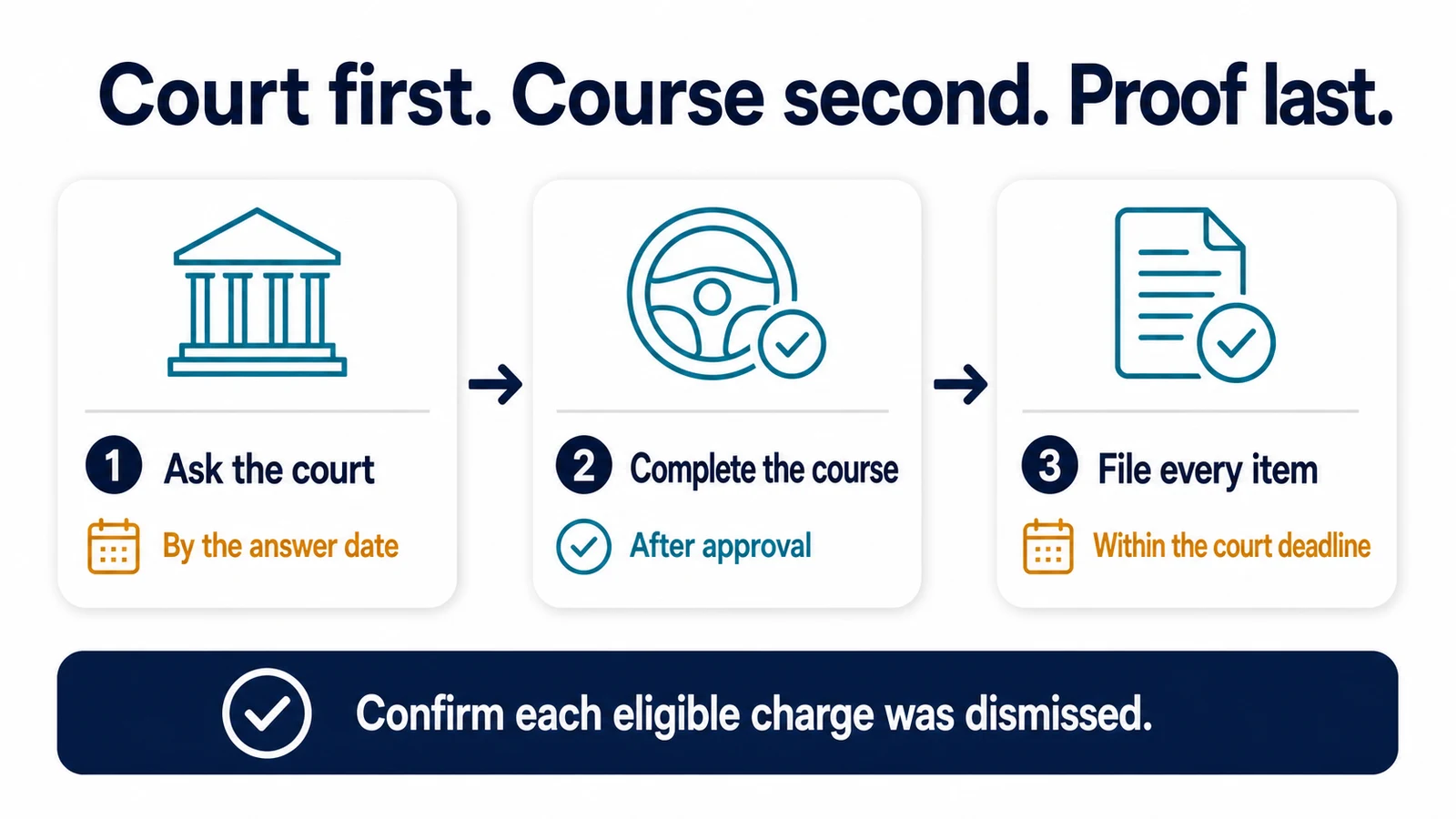
How to complete the Texas ticket-dismissal process
Step 1: Read the citation and identify the court
Record the court name, citation number, offense date, answer date, exact charges, alleged speed, and any work-zone or collision notation. Do not send paperwork to DPS or TDLR when the citation directs you to a municipal or justice court.
Step 2: Request the course by the answer date
Use the court’s official form or portal. Enter the plea required for this procedure, provide the requested license and financial-responsibility evidence, sign the affidavit, and pay the amount the court requires. Keep a dated receipt and a copy of everything submitted.
If you are deciding whether to use the dismissal route or challenge the allegation, make that decision before entering the plea. Our traffic school vs. court guide outlines the general tradeoffs, but it cannot determine the best legal choice in a particular case.
Step 3: Wait for approval and read the order
Do not treat a pending online submission as approval. Confirm that the court accepted the request and note the completion date, proof method, and every required item.
Step 4: Choose a currently approved course
Verify the provider and course through the TDLR license search. A familiar brand name or a “Texas-approved” badge is not a substitute for a current license result.
Texas Education Code Section 1001.352 now states: “A driving safety provider shall charge each student at least $25 for a driving safety course.” A separate $3 materials, supervision, and administration fee was required until September 1, 2025, when House Bill 3012 removed it. Older pages may still quote $28 as the floor.
The $25 floor is not necessarily the complete checkout price. Before paying, compare:
- the complete required price;
- online or classroom delivery;
- identity checks and completion rules;
- certificate timing and delivery;
- customer-support hours;
- refund terms; and
- optional driving-record or expedited-delivery charges.
Do not confuse a six-hour driving safety course with the six-hour adult driver-education course used by some first-time license applicants. They serve different purposes and issue different certificates.
Step 5: Order the correct driving record if required
Texas DPS lists several record types. Its online record-types page marks Type 3A, the certified list of all accidents and violations, as acceptable for a defensive-driving course. It marks Type 2A unacceptable. The uncertified types carry no acceptance note, so do not substitute one.
Some judges may retrieve the record through the state portal. Article 45A.359 authorizes a reimbursement fee equal to the Transportation Code Section 521.048 record fee plus the state electronic Internet portal fee, and directs DPS to provide the record as soon as practicable. Follow the court’s order before buying a separate record.
If you must order the record yourself, use the official DPS driver-record page. DPS labels Type 3A as the only listed record type usable for a defensive-driving course, while its FAQ says most courts generally require Type 3A and tells drivers to confirm the exact type with the specific court. Save the file exactly as instructed.
Step 6: Submit every required item and verify dismissal
Check the certificate for the correct name, citation, court information, and completion date. Sign it if the court instructs you to do so. Submit it with the driving record, affidavit, and any other ordered document through the court’s approved method.
Keep:
- the court’s course approval or order;
- payment receipts;
- course registration and completion records;
- the uniform completion certificate;
- the Type 3A record or proof that the court retrieved it;
- the signed affidavit; and
- final confirmation that each eligible charge was dismissed.
Course completion alone does not close the case. Confirm the court received and accepted the proof and that the docket shows the expected disposition.
What happens if you miss a requirement?
If the evidence is incomplete or late, Article 45A.356 directs the court to notify the defendant and require a show-cause appearance. If the defendant does not appear, or appears but does not show good cause, the court enters an adjudication of guilt and imposes sentence.
Do not ignore a notice because you finished the online lessons. A course certificate does not cure a missing affidavit, wrong record type, unpaid amount, or unfiled court document by itself.
Contact the court promptly if approval, certificate information, record access, timely filing, or the final docket status becomes a problem.
Frequently asked questions
Do I have 90 days to ask the court?
No. The ordinary request must reach the court through an authorized method on or before the answer date on the notice to appear. The 90-day period applies after the court proceeds under the course-dismissal procedure.
Does dismissal keep the charge off my driving record?
Article 45A.357 keeps the dismissed charge off your record. Under Article 45A.356(c)(2)–(3), the court reports the course completion and its date to DPS and states whether it was taken under this subchapter so eligibility for a later course can be determined. The required record and affidavit also help the court check the 12-month rule.
The bottom line
A Texas driving safety course works as a court-supervised dismissal procedure, not as a stand-alone online purchase. The answer-date request comes first. Court approval, a currently TDLR-approved course, the correct DPS record or court retrieval, the affidavit, and timely proof all matter.
Start with the court named on the citation, keep copies at every step, and do not consider the job finished until the court confirms that each eligible charge was dismissed.
Drive Wise. Spend Less. Stay Safe.
Related Reading
- Traffic school rules by state
- Traffic school vs. court: which option fits?
- Should you pay a ticket or choose traffic school?
- Does traffic school remove a ticket from your record?
- Speeding-ticket costs by state
Sources
- Texas Code of Criminal Procedure, Chapter 45A, Subchapter H — Driving Safety or Motorcycle Operator Course Dismissal
- TDLR — SB 296: Driving Safety or Motorcycle Operator Training Course Dismissal
- Texas Legislature — H.B. 3012 enrolled text, amendment to Education Code § 1001.352
- TDLR — Driving Safety Providers Must Charge Students a Fee Before Enrolling Them
- TDLR — Driver Education and Driving Safety license search
- Texas DPS — How to Order a Driver Record
- Texas DPS — Driver-record FAQ, Section 5
- Texas DPS — Driver Responsibility Program repeal
Last updated: September 2, 2026.