


Georgia Driver Improvement Insurance Discount: Eligibility and Certificate Rules

Confirm your policy’s eligibility and your insurer’s course requirements before paying for a class.
Last reviewed: September 7, 2026
A Georgia driver improvement insurance discount must be offered on qualifying personal-auto policies when all named drivers meet the applicable age, driving-history, and training requirements. The reduction applies to specified coverage premiums, so it is not necessarily 10% of your entire bill.
For a qualifying Georgia personal or family private-passenger policy, O.C.G.A. §33-9-42(a) states:
“there shall be offered by the insurer a reduction of not less than 10 percent in premiums for motor vehicle liability, first-party medical, and collision coverages to the policyholder if all named drivers, as listed or who should be listed on the policy application or provided in information subsequent to such application, of each motor vehicle covered by such policy satisfy the requirements of subsection (b) or subsection (c), as applicable”
Before paying for a course, ask your insurer to check everyone who belongs on the policy. A qualifying class for an adult age 25 or older does not satisfy the younger-driver training rule by itself. Your certificate also needs to match every purpose you intend to use it for.
This guide helps you check the policy, identify the right training, and collect the insurer’s acceptance and savings details before enrolling.
Quick answer
- Check every named driver, including anyone who should be listed.
- Age 25 or older: the law provides qualifying defensive-driving routes.
- Under 25: the statutory training route requires at least 30 classroom hours and six practical hours.
- Confirm the accepted course and certificate with your insurer before paying. §33-9-42(a)–(c)
Start here: check which insurance situation applies.
Do not enroll yet if…
- A court or DDS also requires a course. Confirm its program and proof requirements separately before choosing an insurance-only certificate.
- A named driver is under 25. Ask which driver-training records the insurer needs.
- You hold a CDL or have an out-of-state license or policy. Ask the insurer about the policy’s eligibility and the relevant court or licensing agency about any separate course use.
- You are unsure whether a recent offense or claim disqualifies the policy. Get an eligibility answer before buying training for savings.
Which insurance situation applies to you?
Start with the drivers and policy, then choose the course. This table routes you to a verification step; it does not approve your coverage for a discount.
| Your situation | What changes the decision | Your next step |
|---|---|---|
| Every named driver is 25 or older | Each needs the applicable clean history and a qualifying course | Ask your insurer whether each driver on your policy qualifies and which course each needs |
| At least one named driver is under 25 | Younger drivers have a separate classroom-plus-practical training requirement | Check the driver-education records you already have before you pay for another class |
| A named driver has a recent traffic offense or fault-based claim | The standard history conditions may not be met | Ask your insurer whether it offers you a discount outside the standard rule |
| Only one of several named drivers plans to attend | One completion does not establish that everyone qualifies | Ask what proof you need for every other driver on your policy |
| You also need court, points, or reinstatement credit | Certificate purpose affects its permitted uses | Tell your clinic all the ways you need to use your certificate before it issues one |
The insurance branches follow §33-9-42(a)–(d), (h). The certificate restriction comes from Rule 375-5-1-.04(1)(h).
Who qualifies for the Georgia insurance discount?
The required offer applies to a personal or family-type private-passenger motor-vehicle policy issued or issued for delivery in Georgia. Every named driver of each covered vehicle must satisfy the requirements for their age group. The statute includes drivers listed on the application, supplied afterward, or who should be listed. §33-9-42(a)
Review the policy’s driver list with the insurer. Do not treat an incomplete list as a way to meet the rule. Likewise, the test concerns named drivers, not simply everyone sharing an address.
Named drivers age 25 or older
Each named driver in this age group must meet these conditions:
- Traffic offenses, (b)(1): “Have committed no traffic offenses for the prior three years or since the date of licensure, whichever is shorter”
- Fault-based claims, (b)(2): “Have had no claims based on fault against an insurer for the prior three years”
- Completion of one of the qualifying courses specified in the statute. §33-9-42(b)
The shorter-since-licensure exception applies to traffic offenses. It does not shorten the separate three-year fault-based-claims condition. Keep those questions separate when speaking with the insurer.
One qualifying route is a defensive driving course of at least six hours through a driver improvement clinic or commercial or noncommercial driving school approved by and under DDS jurisdiction.
Other routes are:
- Nonprofit programs: at least six hours through an organization such as AARP, AAA, the National Safety Council, or a comparable organization, meeting DDS rules under subsection (g). §33-9-42(b)(3)(C), (g)
- Employer programs: at least six hours, offered to employees and their immediate families, meeting DDS rules. §33-9-42(b)(3)(D)
- The emergency vehicles operations course at the Georgia Public Safety Training Center. This separately named route does not carry the six-hour minimum stated for the defensive-driving alternatives. §33-9-42(b)(3)(B)
AARP illustrates why the purpose matters. The insurance statute names it as an example of the nonprofit route, subject to those course standards. DDS FAQ Q10 names AARP as an example of courses not approved by DDS for driver’s-license-related issues. An insurance course is not automatically a license-purpose course. Confirm the specific offering with your insurer. DDS FAQ, question 10
Named drivers under 25
Each younger named driver must meet the same distinct offense-history and fault-based-claims tests. Their training requirement is different. §33-9-42(c)(3) requires:
“Complete a preparatory course offered to new drivers of not less than 30 hours of classroom training and not less than six hours of practical training by a driver’s training school approved by and under the jurisdiction of the Department of Driver Services or by an accredited secondary school, junior college, or college.”
A six-hour driver improvement class alone does not satisfy this training requirement. If the younger driver already completed driver education, ask the insurer to review that proof before arranging additional training.
Policies with both age groups
A policy with older and younger named drivers needs both sets of requirements addressed. For example, a parent’s qualifying defensive-driving certificate does not establish the younger named driver’s classroom and practical training. The younger driver’s training record does not establish the parent’s course completion either.
Use a separate line for each driver when collecting proof. Ask the insurer to identify precisely whose eligibility or document is still missing, rather than accepting a general answer that the policy needs “a certificate.”
How much can the discount save?
The statutory minimum is 10% of the premiums for the three named coverages: motor-vehicle liability, first-party medical, and collision. It is not a promise that every component of the policy bill receives that reduction. §33-9-42(a)
Ask your insurer how many dollars you would save. You need that quote before you can compare savings with course costs. Count every driver on your policy who still needs training.
| Ask your insurer to fill in | Why you need it |
|---|---|
| Which coverages get the discount? | Shows which parts of your bill count |
| How many dollars will you save per policy period? | Lets you compare savings with your course costs |
| When will your discount start and end? | Prevents counting savings before they begin |
| How does this affect discounts you already have? | Shows how much less you would actually pay |
| Who still needs a course, and what proof do you need? | Shows what qualifying will cost you |
To work out when you would recover your course costs, divide the total you must spend on courses by your quoted savings per policy period. Use this only if your insurer has confirmed a positive savings amount. The result tells you how many equal periods of those savings you would need to cover tuition. It assumes your savings continue.
Add travel costs or lost pay if they matter to you. Check whether you would recover your costs before your discount ends. This is a way to plan your spending, not a forecast of your future bill.
If your insurer cannot yet tell you whether you qualify or how much you would save, wait before you buy a course solely for the discount.
How long does eligibility last?
After each named driver completes the applicable course, §33-9-42(d) provides:
“eligibility for reductions in premiums for such policy shall continue for a period of three years, provided any named driver under such policy does not commit a traffic offense or have a claim against the policy based on any such driver’s fault.”
A later offense or qualifying claim can end eligibility before that period finishes.
That duration is not a promise of a fixed total premium. Ask the insurer for the discount’s recorded start and end dates, particularly when drivers completed training on different dates.
The statutory provision does not establish a universal certificate-processing deadline or immediate repricing date. Confirm when the insurer will apply the reduction and when any later loss of eligibility would affect the bill. Save that answer with the certificates.
What if you have a ticket or an at-fault claim?
A driver who fails the applicable history test cannot rely on the standard required-offer pathway. However, §33-9-42(h) states:
“Nothing in this Code section shall prevent an insurer from offering the reduction in premium specified in subsection (a) of this Code section to a driver who does not meet all of the requirements of subsection (b) or subsection (c), as applicable, of this Code section.”
That broader offer is permissive, not guaranteed.
Ask: “Does our policy qualify under the standard Georgia rule, or do you offer a separate voluntary option for our situation?” Request the actual conditions for that option.
Keep insurance eligibility separate from any point reduction or court outcome. An insurer needs to assess the facts relevant to its discount; a course certificate alone does not establish that the traffic-history condition is met. If a ticket’s disposition is uncertain, describe that status accurately instead of treating a low or zero point total as proof of an offense-free history.
If no reduction is available, do not buy a class expecting it to repair that eligibility problem. A court or DDS requirement may still need attention, but it has its own purpose and instructions.
Which certificate should you request?
Request a certificate that reflects every intended use, and confirm the insurer’s document requirements before enrollment. Rule 375-5-1-.04(1)(h) specifies:
“Students who are taking a class for the purpose of insurance reduction only, without any requirement by any court, Department point reduction or reinstatement purpose, or out of state reinstatement, shall be issued a Certificate of Completion appropriately noted as required by the format of the Certificate.”
The same paragraph expressly says an insurance-only certificate cannot be used for reinstatement, point reduction, out-of-state reinstatement, or a court requirement. Tell the clinic all your intended uses before it issues the certificate. For dual reinstatement-and-points use, DDS also instructs you to declare both purposes when you submit the certificate at a DDS Customer Service Center. Rule .04(1)(h); DDS FAQ, question 14.
Check the fee against the purpose
The $95 fee comes from O.C.G.A. §40-5-83(a)(1):
“Approved clinics shall charge a fee of $95.00 for a defensive driving course, except that such clinics may charge different fees of their own choosing if the person is not enrolling in such course pursuant to court order or department requirement”
DDS says clinics must charge $95 for court, points, or reinstatement purposes, and may charge up to $95 for insurance or education. This clinic guidance is not a universal price for every alternative course route in the insurance statute. DDS FAQ, question 17
A price below $95 is a signal to check: it may be an insurance-or-education offering or an incorrect advertisement, not a compliant discount on the required court/DDS-purpose course. Price alone cannot prove the certificate’s uses. Ask the clinic before paying.
Keep your certificate while you still have access to a replacement
Keep your certificate and proof of submission. DDS says clinic records are retained only three years. To replace a lost certificate, contact the clinic; the fee may be up to $5. If the clinic has closed and you attended within the past three years, call 678-413-8745. In its lost-certificate guidance, DDS says that beyond three years you must retake the course. This is a replacement-record issue, not a promise that insurance eligibility lasts longer. DDS FAQ, question 7
Can an online course qualify?
For an insurance discount, get the insurer’s acceptance of the exact course and delivery format before purchasing. DDS FAQ, question 6 says:
“Check with your insurance company to see if you or your family members are eligible for the reduction. For all qualifications you may also refer to O.C.G.A. § 33-9-42.”
For a separate license-related use, DDS FAQ, question 12 says online certificates are:
“not accepted by the DDS for any purposes related to an individual’s driver’s license or driving privileges.”
The specific remote-classroom rule provides a DDS-approved synchronous route. Under Rule 375-5-1-.09(9)(b), instruction must involve real-time interaction; (9)(c) requires notification and prior DDS approval. Subparagraph (9)(a) addresses emergency-policy authority. A live, approved remote classroom and a self-paced online course are different formats.
The FAQ does not explain that distinction. Do not treat the rule’s “Location of Driver Improvement Clinic” heading as proof that a particular online offering qualifies. Get current DDS confirmation of the specific remote offering’s approval and confirm acceptance with the court or other recipient. A Zoom advertisement alone proves neither.
An insurer’s acceptance does not establish court or DDS acceptance. Get each answer before selecting a remote class for multiple purposes.
Use this insurer-confirmation worksheet before paying
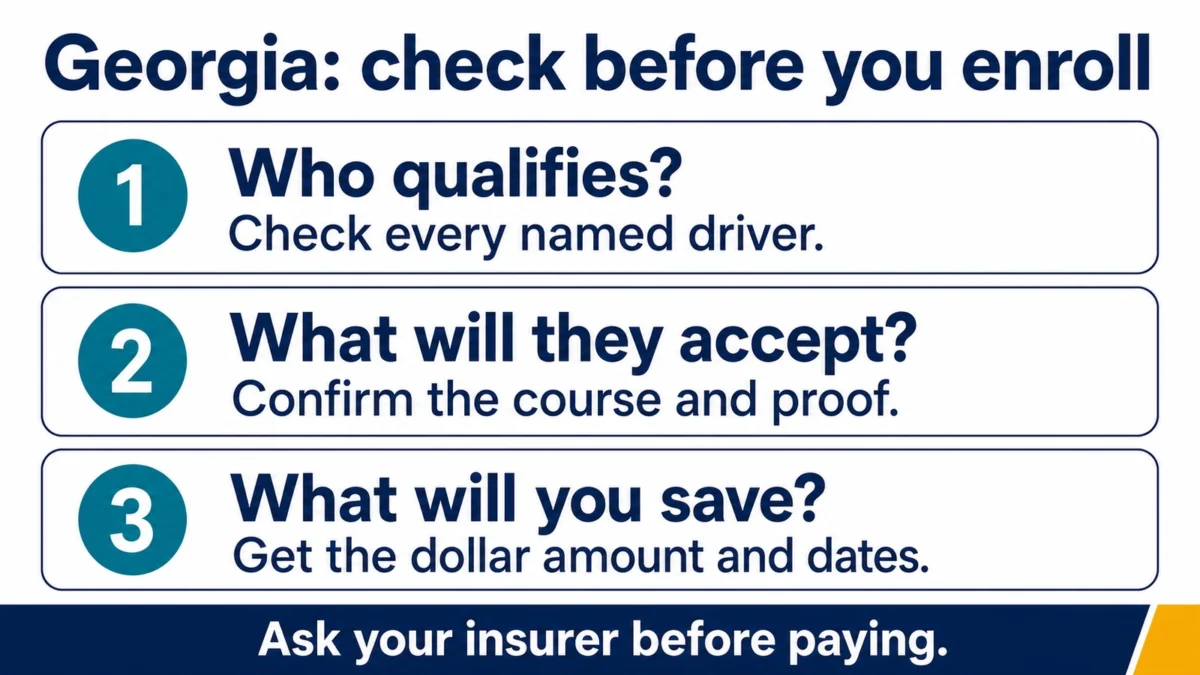
Get your insurer’s answers before enrolling, then compare the confirmed savings with the course cost.
Work through these questions with your insurer before you call a school. You can copy them into your notes and put each answer beside the question. Save the date and any written reply so you can refer to it later.
- Your policy: “Does my Georgia personal or family private-passenger policy qualify?”
- Your drivers: “Who is listed, and who should be listed on my policy? Which age rule applies to each?” Check the names against your own records.
- Your driving history: “Do we meet both the traffic-offense and fault-based-claims tests? If not, can you offer us another discount?”
- Your courses: “Which certificates do I already have that you can use? Who still needs training, and which exact course and format will you accept?”
- Your proof: “What must I send for each driver, where do I send it, and can I send a copy?” Ask how you will know it arrived.
- Your savings: “How many dollars will I save, on which coverages, and when will the discount start and end?” Compare that answer with what you must spend.
- Your other course needs: If you also have a court or DDS task, check its instructions with that recipient and your clinic. Tell both how you intend to use your certificate.
- Your price check, with the clinic: If you see a price below $95, ask whether it is for insurance or education only. If you need court or DDS use, resolve the price and certificate mismatch before paying; the ad may be wrong.
When you finish the course, check the name and course details on your certificate. Send your proof where your insurer told you to send it. Save the receipt or reply. You should then check your policy documents for the agreed discount. If your bill differs, show your insurer the written answer you saved and ask what changed.
You should leave this process knowing what to do: take the confirmed course, send proof you already have, or keep your money because no discount has been approved.
Frequently asked questions
Does one person’s course qualify the whole policy?
Not by itself. The statutory offer depends on all named drivers meeting the applicable requirements. Ask the insurer which other drivers already qualify and whose proof is missing. §33-9-42(a)–(c)
Can a driver under 25 use the six-hour class instead of driver education?
Not for the standard under-25 training requirement. That provision requires at least 30 classroom hours and six practical hours through a qualifying school. An insurer may offer a broader voluntary reduction, but it must confirm that option. §33-9-42(c), (h)
Does holding a CDL automatically rule out the insurance benefit?
Do not infer that from this provision. Its stated scope is qualifying personal or family private-passenger coverage. Ask the insurer to assess your policy and driver eligibility, and handle any commercial-license or court requirements separately. §33-9-42(a)
Will the clinic arrange the insurance discount for me?
Do not assume it will. Ask the insurer who must send proof and how acceptance will be confirmed. DDS refers insurance-eligibility questions to the insurance company. DDS FAQ, question 6
Confirm eligibility before choosing a class
Before you choose a class, have your insurer check everyone who belongs on your policy. Ask what training you still need, how much you would save, and which certificate to send. Tell your clinic if you also need the course for court or DDS.
Use the worksheet to get answers you can act on. Once you know the course and proof your insurer will accept, you can decide whether the savings are worth your time and money. Keep using the safer-driving habits you learn after you finish the paperwork.
General information only: This guide explains Georgia’s general insurance and course rules. Your insurer must assess your policy and documents; it is not individual legal or insurance advice.
Related Reading
- How traffic-school insurance discounts work
- How traffic violations can affect your premiums
- Other ways to lower your car insurance costs
- What a defensive driving course covers
- What to check before paying for online traffic school
Sources
- Georgia §33-9-42 — free section text, (a)–(d), (g), (h): reader-accessible 2025 reproduction, compared with the preserved official capture on September 6, 2026.
- Georgia §40-5-83 — free section text, (a)(1): clinic fee and its exception; 2025 reproduction compared with the same official capture on September 6, 2026.
- Official Georgia Code through Lexis, O.C.G.A. §33-9-42(a)–(d), (g), (h), and §40-5-83(a)(1): authority of record for the insurance rules and clinic fee. Official text reviewed from the preserved September 5, 2026 capture; publisher currency supplied as through the 2026 Special Session. The link opens the code entry point; search the section number.
- Georgia DDS Defensive Driving Program FAQs, questions 6, 7, 10, 12, 14, and 17: insurer referral, replacement certificates, insurance-versus-license uses, online license/privileges warning, dual-use submission, and purpose-based fees. Rechecked September 6, 2026.
- Georgia Rules and Regulations, Subject 375-5-1, .04(1)(h), .09(9)(a), (b), and (c): certificate purposes and express restrictions, emergency-policy authority, synchronous remote instruction, and prior approval. Rechecked September 6, 2026.
Last updated: September 7, 2026


