

Can You Keep a Traffic Ticket Off Your Record Before It Affects Insurance?
A ticket does not automatically become a conviction on your driving record. Depending on the state, court, charge, your driving history, and license type, you may be able to get the case dismissed, put on hold, reduced to a lesser charge, or kept off the record insurers can see.
Those results are not the same. A course that dismisses an eligible ticket in one state may only keep points off your license, change a point calculation, or earn an insurance discount in another.
Can You Keep a Traffic Ticket Off Your Record?
Sometimes. Start by asking the court what each option would do in your case. Common results include:
- Dismissal after you finish an approved program
- A deferred program that may end without a final conviction
- A reduction to a lesser charge
- Confidential record treatment or withheld points without dismissal
- A point reduction used only to decide whether your license may be suspended
- A defensive-driving discount that changes the price of insurance but not the court or driving record
Most options must be requested by the response or appearance date printed on your ticket. Before you enroll in a course or pay, ask the court what each choice would do.
| Option | Possible legal outcome | Point treatment | Possible insurance effect |
|---|---|---|---|
| Traffic school or court-approved course | Dismissal, withheld adjudication, confidential record treatment, point reduction, or no record change | Depends on the state | Depends on state law, reporting rules, and the insurer |
| Court dismissal or acquittal | No conviction on the dismissed or acquitted charge | Usually no conviction points, subject to state rules | The court or agency may still keep a record; insurer treatment varies |
| Deferred program | May end in dismissal or no final conviction if you finish every condition | Depends on the state | May avoid or reduce an insurance effect, but not in every case |
| Charge reduction | The original charge is replaced by a lesser offense | Based on the new offense | Based on the new offense and the insurer’s rules |
| Paying or admitting the ticket | Often ends the case as a conviction or admission | Points apply only if state law assigns them to the offense | The conviction may affect the insurer’s decision or price |
This article gives general information, not legal advice. For your case, follow the ticket and the court’s instructions. Your state motor vehicle agency and a qualified local lawyer can explain other rules that may apply.
Why Your Driving Record Matters
An insurer may check your driving record when you buy or renew a policy. When it checks, how far it looks back, and how it treats a conviction depend on the state and insurer.
One insurer may give a minor violation little weight while another raises the price. Your earlier violations, the seriousness of the charge, your rating group, and state insurance rules can all change the result.
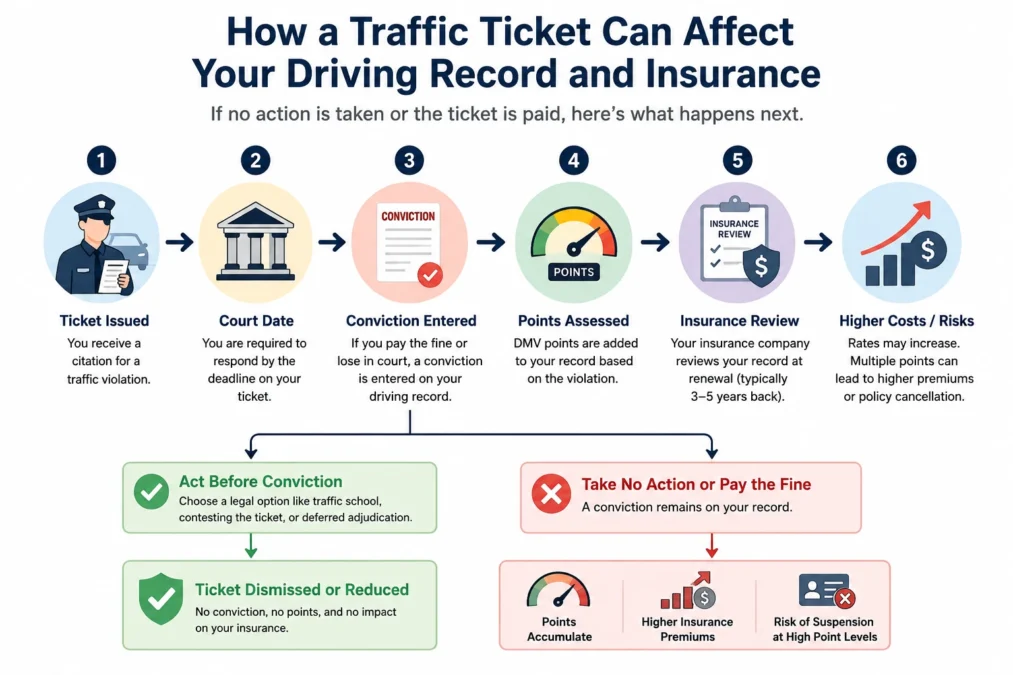
In states that use driver points, some violations add points to your license. If you reach the state’s limit, you could face a warning, hearing, suspension, or another agency action. States use different point systems, and DMV points are not the same as an insurer’s rating factors.
Method 1: Check for a Court-Approved Course
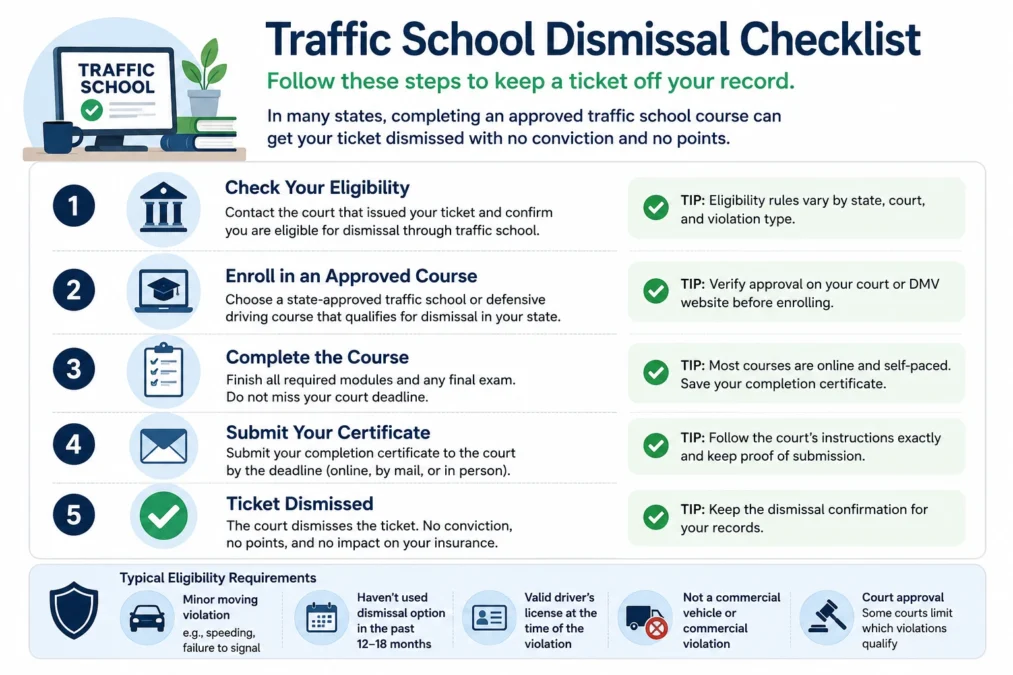
If your court allows it, an approved course can lead to dismissal, withheld adjudication, confidential record treatment, or fewer points. These results are different. No course can guarantee nationwide that a ticket will stay off your record or will not affect insurance.
How to check the option
- Read the ticket and court notice for the response or appearance deadline.
- Ask the listed court whether you and the charge qualify for a course that changes how the case ends.
- Ask whether the result would be dismissal, withheld adjudication, confidential record treatment, fewer points, or only an insurance discount.
- Confirm the approved provider, course format, fees, and completion deadline before enrolling.
- Complete the course and submit the certificate exactly as instructed.
- Confirm that the court applied the result it promised. Do not assume the case was dismissed or reported a certain way until the court records the outcome.
Your charge, alleged speed, commercial-license status, vehicle type, prior course use, and request date can affect whether you qualify. The rules differ by court and state.
Before you pay, read the ticket and the court’s official instructions. Paying can end the case as a conviction or admission. But some official programs require you to pay fines, fees, costs, or bail when you choose the program. Ask the court what the payment would do in your case.
Method 2: Contest the Ticket in Court
You can usually fight a ticket. The court that issued it sets the procedure. The case may end in dismissal, acquittal, a lesser charge, or conviction of the original charge.
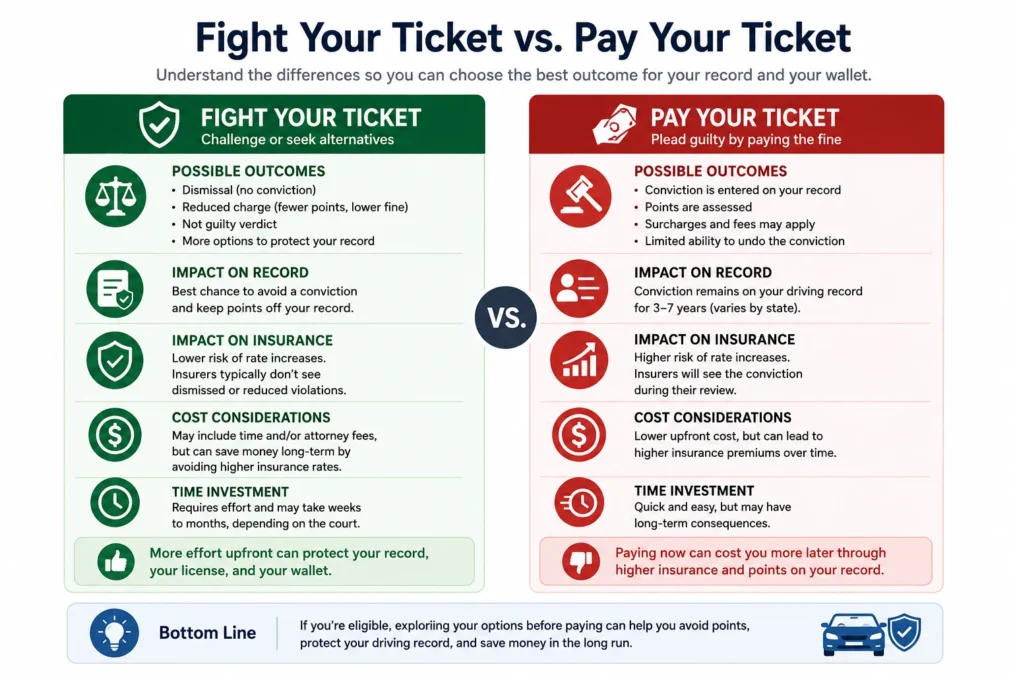
Fighting the ticket may be worth considering when:
- The ticket contains an important error
- Documents, photographs, video, or witness evidence contradict the allegation
- The charge could have serious licensing or insurance consequences
- You need advice about a commercial license, criminal traffic charge, crash, or injury
For a serious charge, compare the cost of a lawyer with the possible fine, license consequences, and insurance impact. A lawyer cannot promise dismissal or savings, but a local traffic lawyer can explain your defenses and the court process.
Method 3: Ask About Deferred Disposition
Some courts offer deferred disposition, deferred adjudication, or a similar program. You usually must meet certain conditions for a set time. If you do, the court may dismiss the case or close it without a final conviction where the law allows.
The rules, length, fees, eligible charges, and reporting results depend on the court. Before you agree, ask the court to put in writing how the case will end.

A continuance only moves the hearing date. Local rules decide whether the court grants it, whether the officer or prosecutor must appear, whether there is a fee, and what happens if someone does not show up. Do not assume that a continuance will lead to dismissal.
Method 4: Ask Whether a Charge Reduction Is Available
Where local law allows, a prosecutor or court may agree to a lesser charge. A nonmoving or reduced offense can carry fewer or no driver points. What matters is the charge that replaces the original one.
How the DMV and insurer treat the new charge still depends on the state and insurer. Before accepting a deal, ask:
- What offense will appear on the court record?
- Will the state motor vehicle agency receive it?
- Does the amended offense carry driver points?
- Are there fines, costs, conditions, or future consequences?
What Not to Assume
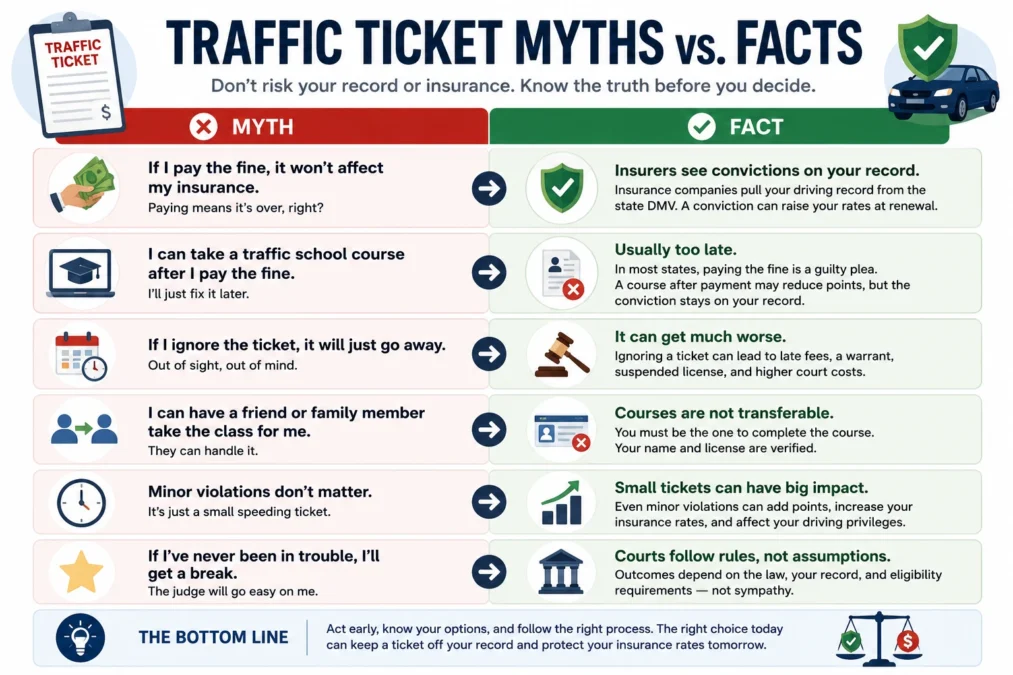
Do not assume an insurer will never see the conviction. Insurers can order driving records or other consumer reports when they decide whether to offer a policy or set its price. Insurers check records and rate violations in different ways.
Do not assume a course taken after payment will undo the conviction. A later course might give you a point credit or insurance discount. In general, it will not erase the conviction unless the court grants relief after the case ends.
Do not falsely identify another driver. A false statement to a court or law-enforcement agency can lead to criminal charges. The charge and penalty depend on local law.
Do not assume every state sends every violation to every insurer at each renewal. There is no single nationwide process. Insurers check driving records at different times, so do not assume a conviction will stay hidden or will not affect the price.
If the Ticket Is Already on Your Record
After the court enters a conviction, the usual programs for avoiding one are often closed. You may still be able to ask the court to reopen or correct the case, file an appeal, or seek another form of relief. The rules and deadlines depend on the court and your reason for asking.
Possible next steps include:
Verify the record
Order an official driving record from your state motor vehicle agency. Check the charge, how the case ended, the date, and the points. If something is wrong, use the agency’s correction process.
Check for a point or insurance benefit
Some states offer point credits or insurance discounts for approved courses. A point credit does not erase the conviction, change the insurer’s rating system, or promise a lower premium.
New York illustrates the distinction: its Point and Insurance Reduction Program does not remove the violation, conviction, or points from the driving record. Its point benefit applies to suspension calculations, while the insurance reduction is a separate benefit.
Read what you can do after points have been added before enrolling in a course.
Compare insurance at renewal
Insurers often look back several years, but the exact period depends on the state, insurer, and violation. Do not assume every minor violation stops affecting the price after exactly three years.
If your premium goes up, compare quotes for the same drivers, vehicles, coverage limits, deductibles, and optional coverage. The NAIC auto insurance guide explains common coverage terms that can help you compare policies on equal terms. Keep your old policy until the new coverage is confirmed.
For more detail, see How Traffic Violations Affect Insurance Rates After a Ticket.
State Examples: Similar Courses, Different Outcomes
States use different procedures. These examples show why you need to know the exact result.
California
If you qualify as a noncommercial driver, California traffic school can keep the point off the driving record insurers see. The court must approve, and other rules apply. The California Courts Self-Help Guide says the court notice should tell you whether you qualify and that you must use a DMV-approved school.
Texas
Texas Code of Criminal Procedure Chapter 45A lets an eligible driver ask for dismissal through a driving safety course. The rules cover your license, recent course use, request deadline, proof of insurance, alleged speed, type of charge, and commercial-license status.
The law generally looks at whether you finished an approved course during the 12 months before the charge. If you request the option on time, qualify, and finish the course, the court can dismiss the case. Check the exclusions first.
Florida
Florida lets eligible drivers choose a Basic Driver Improvement (BDI) course, but §318.14(9) does not set the election deadline. A separate rule gives a person who does not choose to appear in court 30 days from the ticket date to pay the fine or start a payment plan. That payment counts as admitting the violation and giving up the right to a hearing (§318.14(4)(a)–(b)). Ask the clerk how and when to choose BDI, pay, and submit any fees.
If you qualify and follow the BDI rules, you still pay the ticket. The fee may be lower, adjudication is withheld, and points are not added. That is not the same as dismissal, and it does not promise an insurance result.
New York
New York’s Point and Insurance Reduction Program does not remove the violation, conviction, or points from your driving record. It can lower the point total used for certain suspension decisions. If you meet the rules, it also provides a separate insurance discount.
Frequently Asked Questions
How long do I have to request a course or dismissal option?
There is no nationwide deadline. Use the response or appearance date printed on your ticket and ask the listed court what to do. Florida §318.14(9) does not set a BDI election deadline. Its separate 30-day rule covers payment or a payment plan for someone who does not choose to appear in court (§318.14(4)(a)). In Texas, the statutory request process is tied to the answer date on the notice to appear, subject to the law and the court’s authority.
Can an out-of-state driver use traffic school?
The court that issued the ticket controls how the case ends. You may be able to take an approved course elsewhere, but ask the issuing court whether it will accept that course before you enroll.
What happens if the officer does not appear?
An officer’s absence does not always mean dismissal. Local rules may let the court dismiss the case, move the hearing, or go forward with other evidence. Show up unless the court officially says you do not have to.
Will a dismissed ticket appear on a background check?
A dismissed ticket is not a conviction. But ticket and court records may remain public unless state law makes them confidential or the records are sealed or expunged. Driving-record and background-check rules differ by state.
Can I take an online course?
Some courts accept approved online courses; others limit the provider, format, or purpose. Before you enroll, confirm that the court accepts the specific course for the result you want.
Does paying immediately mean I am convicted?
Paying can end the case as a conviction or admission, but the rule is not the same everywhere. Some official programs include payment when you choose the program. Read the ticket and the court’s instructions before you pay, fight the charge, or ask for another option.
Will dismissal guarantee that my insurance rate will not change?
No. The result depends on what the court and motor vehicle agency report, which records the insurer checks, the insurer’s rating rules, and state insurance law.
Before You Pay
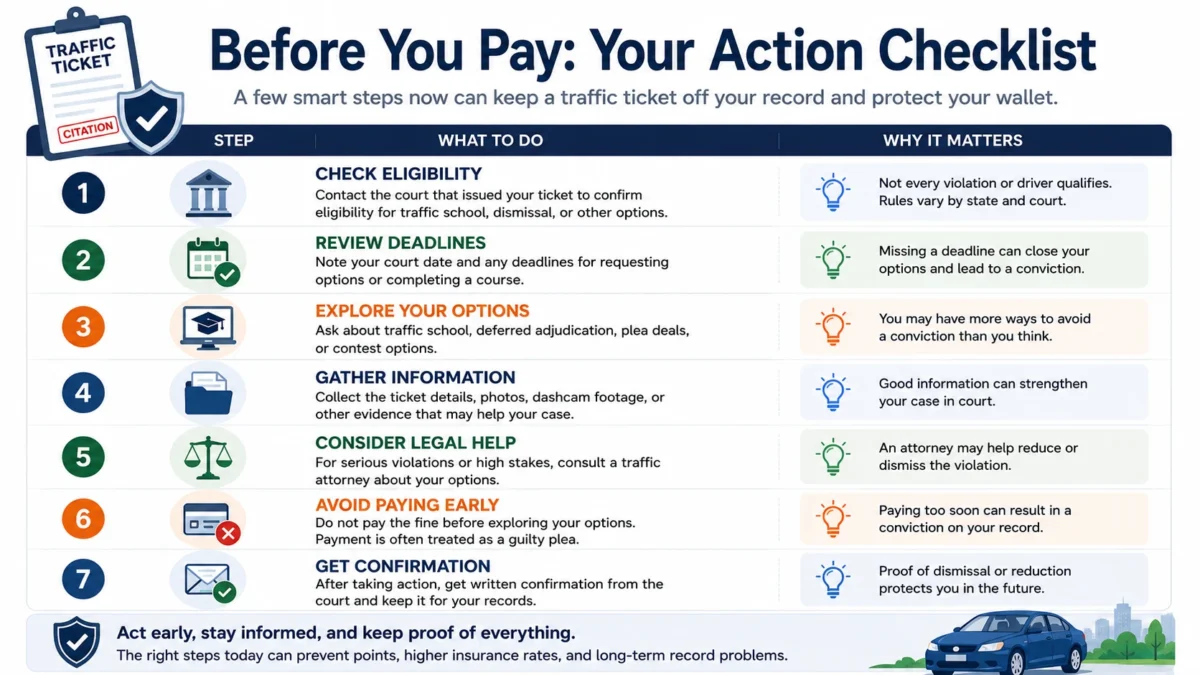
Deadlines and the effects of paying or missing court differ. Use the response or appearance date on your ticket and ask the court which options are still open before that date passes.
Use this checklist:
- Read the entire ticket and court notice
- Confirm the response or appearance deadline
- Ask the court which case outcomes are available
- Identify the exact result: dismissal, a deferred program, a lesser charge, confidential record treatment, fewer points, or an insurance discount
- Confirm course approval before enrolling
- Consider local legal advice for a serious charge, commercial license, crash, or possible suspension
- Keep proof of every filing, payment, certificate, and final court result
If the court offers a course, compare the exact result, who qualifies, the cost, the deadline, how it will be reported, and the insurance effect. A course approved for an insurance discount may not qualify for ticket dismissal.
Related Reading
- How to Get a Speeding Ticket Dismissed Before It Hits Your Record
- Should I Fight a Speeding Ticket? 5 Signs It’s Worth It
- Car Insurance Increase After a Ticket: How to Avoid or Reduce It
- Traffic School Insurance Discount: Can It Lower Your Rate?
- How to Avoid Points on Your License
Sources
Sources reviewed August 20, 2026.