

First Speeding Ticket: What Happens Next?
Before you pay your first speeding ticket, find out what payment will do to the case. You need to know whether an appearance is required, whether you can contest the charge, and whether an eligible court program offers a different result.
The amount on the ticket is only part of that decision. The court outcome, your licensing agency’s rules, and your insurer’s treatment of the result are separate questions. Being a first-time offender does not answer them.
General information only: This guide explains how to approach a U.S. speeding ticket. It is not legal or insurance advice. Follow the current instructions from the court or hearing agency handling your case, and check your state’s licensing rules.
Quick answer: Read both sides of the ticket and protect the response deadline. Before paying or entering a plea, confirm your available options and what each would do to the charge and your driving record. If you choose a course or court program, get the eligibility, fees, completion deadline, and required proof in writing.

Read Your First Speeding Ticket Before Choosing a Response
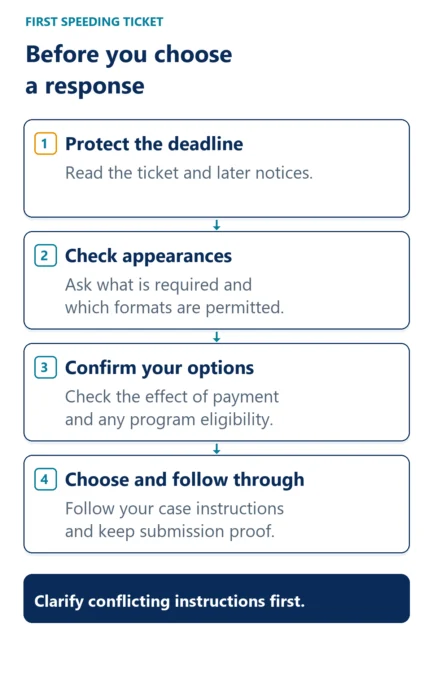
Make a clear copy of the front and back. Locate the alleged speed, posted limit, violation code, issuing agency, and court or hearing agency. Then find the response date and any appearance instructions. Put the deadline in your calendar with enough time to resolve questions before it arrives.
A response deadline may require a plea, hearing request, payment, or another action. Read what the instructions actually ask you to do. If the ticket and a later notice give different directions, contact the agency handling the case to clarify them. Keep the notices together.
Use the agency’s official website or phone number to ask:
- Is an appearance required, and can it be remote?
- What must I submit by the response deadline?
- Does payment enter a guilty plea or admission, and does it close the case?
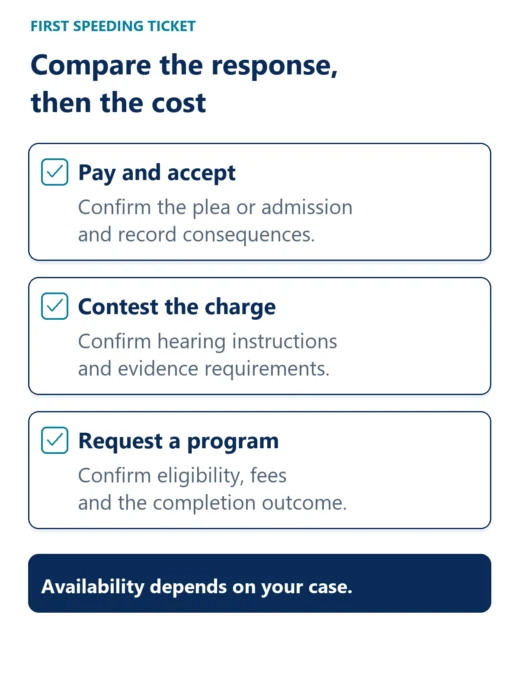
- Is a course, diversion, or other court program available for this charge and license type?
- If I request a hearing or program, do I also need an extension or a separate payment?
Ask procedural questions of the clerk; get legal advice from an attorney if you need help deciding how to plead.
The agency handling a ticket can differ even within one state. In New York, for example, the DMV’s Traffic Violations Bureau handles noncriminal traffic tickets issued in New York City’s five boroughs. Tickets issued elsewhere in the state go through the appropriate local court. Follow the routing on your ticket rather than assuming every case goes to the DMV. New York DMV ticket guidance 1
Compare Paying, Contesting, and Any Available Program
Compare the possible case outcomes as well as the costs. Find out which responses are available before choosing.
| Possible response | What to establish first | Costs to include |
|---|---|---|
| Pay and accept the charge | The plea or admission entered, whether an appearance is required, and the record consequences | Fine, surcharges, other required fees, and possible insurance effects |
| Contest the charge | How to request a hearing, what evidence to submit, and any appearance or deposit requirements | Preparation, travel, time away from work, and attorney fees if you hire one |
| Request an eligible court program | Whether you qualify, the final outcome if you complete it, and what happens if you do not | Court or program fees, course cost, and your time |
Paying: confirm what you are accepting
Payment can resolve a ticket, but it can also accept the charge. For a New York City TVB ticket, New York DMV describes the choice as pleading guilty and paying the required fees, or pleading not guilty and scheduling a hearing. That is a specific process, not a nationwide payment rule. New York DMV 1
For your case, read the payment instructions for the exact legal effect. Check whether you need to request a program at the same time or through a different process. A payment button alone does not explain every available option.
If the amount is unaffordable, ask about payment plans or an ability-to-pay procedure before the deadline. Confirm whether the request changes your response obligations. Financial relief and contesting the charge are different requests.
Contesting: identify the issue you want the court to consider
If you dispute the speed, vehicle identification, location, or another material fact, preserve the evidence while it is available. Save original dashcam files, photographs, relevant records, and witness contact information. Write down what you remember, keeping your observations separate from assumptions.
A disputed fact needs an explanation and supporting evidence. A typo alone is not a sound basis for expecting dismissal. Ask how to obtain relevant case materials and submit evidence through the hearing process; an informal call to the issuing officer is not a substitute for responding to the ticket.
Consider legal advice if the charge threatens your license or employment, involves a commercial license, or includes reckless driving. Ask the attorney what work the quoted fee covers, including appearances and follow-up. For a broader comparison, see Should You Fight a Speeding Ticket?.
A course or court program: confirm the promised outcome
“Traffic school” and “defensive driving” can describe different programs. A course advertised online may have an insurance purpose, a licensing-agency purpose, or a court purpose. Its name does not establish that it satisfies your ticket.
Before enrolling, ask the authority that grants the benefit:
- Am I eligible for this particular charge, speed, license type, and prior program history?
- What outcome does successful completion produce: dismissal, a point benefit, confidential reporting, or something else?
- Which providers and delivery formats are accepted?
- What are the full fees, course deadline, and proof-submission requirements?
- Who sends the certificate, and how do I confirm it was received?
An insurance discount does not establish that the court case has been dismissed. Nor does finishing a class establish that the court has processed your proof.
New York’s Point and Insurance Reduction Program illustrates the distinction: completion does not remove violations, convictions, or points from the driving record. The program affects points used for specified DMV purposes, and it does not prevent premium increases caused by violations or crashes. This is a New York example, not a promise about a course in another state. New York DMV PIRP guidance 3
For more detail, see Traffic School vs. Court, Is Online Traffic School Legit?, and What a Defensive Driving Course Can Do. Use Traffic School by State to find the relevant state pathway, then confirm the requirements for your case.
Keep the Court Result, Points, and Insurance Separate
A ticket states an allegation. The final case result establishes what happened to that allegation. A dismissal and a conviction on a reduced charge are different results; a reduced charge is not the same as having the case dismissed.
Your licensing agency then applies its rules to the reportable outcome. In New York, DMV requires a conviction before adding violation points. That example should not be used to infer another state’s point values or timing. New York DMV point system 2
Look up the exact offense and final disposition when checking your state’s rules. Ask whether any program affects the conviction itself, points used for suspension decisions, or visibility on a particular record. Those benefits are not interchangeable. See Speeding Ticket Points, Driver License Points, and How to Get Points Off Your License.
Insurance is another calculation. The Texas Department of Insurance identifies driving record and claims history as pricing factors in its consumer guide. It also explains that companies decide which discounts to offer and their amounts. These are Texas examples; they do not establish a national surcharge for one ticket. Texas Department of Insurance 4
Ask your insurer how it treats the final offense, whether an eligible course earns a discount, and what proof it needs. Avoid budgeting around a national percentage increase or assuming that a point benefit guarantees an unchanged premium. New York DMV expressly distinguishes its point system from insurers’ systems. New York DMV PIRP guidance 3
Compare the costs you can confirm: court charges, program costs, legal fees, and time away from work. Leave room for any insurance effect you cannot yet confirm. See Car Insurance Increase After a Ticket and How to Lower Car Insurance Costs.
An Out-of-State Ticket or CDL Needs Extra Attention
For a ticket received away from home, start with the court or hearing agency listed on it. Ask about permitted response methods and appearance requirements. Separately, check your home licensing agency’s rules for reporting and handling an out-of-state result.
Do not assume that being licensed elsewhere removes the obligation to respond. New York DMV, for example, describes license suspension for failing to answer certain out-of-state moving-violation tickets, with named state exceptions. Check your own state’s rule rather than extending that example nationwide. New York DMV 1
If you operate a commercial motor vehicle and hold a CDL, federal reporting rules can apply even to a conviction from driving your personal vehicle. Under 49 CFR 383.31(a), a person who operates a commercial motor vehicle, holds a state- or jurisdiction-issued CDL, and is convicted of a state or local motor-vehicle traffic-control violation other than parking must notify their current employer within 30 days after conviction. The rule covers convictions in any type of motor vehicle; subsection (b) specifies the written notification information. 49 CFR 383.31 5
Federal law also limits how the charge can be resolved. Under 49 CFR 384.226, a state must not mask a conviction, defer imposition of judgment, or allow diversion that would keep a CLP or CDL holder’s traffic-control conviction (other than parking, vehicle weight, or vehicle defect violations) off the CDLIS driver record, in any type of motor vehicle. 49 CFR 384.226 6
Check state and employer requirements as well. Get advice specific to commercial driving before relying on a consumer traffic-school offer or deciding how to resolve the charge.
Confirm the Case Is Finished—and the Expected Result Was Recorded
Keep your ticket, court notices, receipts, final disposition, and any certificate together. If you entered a program, track both its completion deadline and any separate proof-submission deadline.
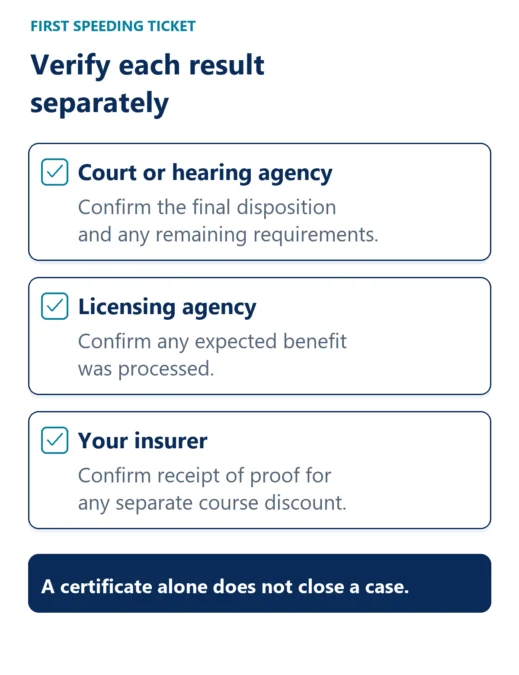
After the required work is done, confirm:
- The court or hearing agency received each required payment and document.
- The final disposition matches the outcome granted in your case.
- No appearance, balance, or program requirement remains outstanding.
- Any expected licensing-agency benefit was processed.
- Your insurer received any certificate needed for a separate discount.
Use the processing time given by the responsible agency. For example, New York DMV’s PIRP instructions tell drivers how to check that completion was recorded and whom to contact if it was not. That follow-up belongs to the course benefit; it does not replace resolving the ticket. New York DMV 3
There is also no single expiration date for every consequence. The period used for a point calculation, visibility of a conviction on a record, and an insurer’s treatment of that record are different questions. New York’s PIRP guidance, for instance, distinguishes point reduction from removing entries from the record. Ask which period matters for the outcome you want. See How Long Points Stay on Your License and How to Keep a Ticket Off Your Record.
Questions About a First Speeding Ticket
Can I get it dismissed because it is my first ticket?
Ask whether your court offers an eligible dismissal or diversion route and what its conditions are. A clean history alone does not establish that such a program exists or that you qualify. If you are contesting the charge, focus on the facts and applicable law. See How to Get a Speeding Ticket Dismissed.
Do I have to appear in court?
Check the citation, later notices, and official case instructions. If an appearance is required, ask about the permitted format. Sending payment or requesting a course should not be treated as a substitute without confirmation from the agency handling the case.
What if I already paid?
Save the receipt and check the recorded disposition. If you intended to request a course or contest the charge, contact the court promptly about any remaining procedure. Do not buy a course on the assumption that it will change a completed case.
What if I cannot find the ticket online?
Contact the court or hearing agency using its official contact information. Give the citation number and ask how to respond while the case is being entered. Keep the stated deadline in view; a missing search result is not confirmation that the ticket was withdrawn.
What if I missed the deadline?
Contact the responsible agency promptly to establish the case’s status and the available next step. Ask whether an order, added charge, or licensing notice has been issued and how to address it. Get legal advice if the instructions or consequences are unclear.
How do I know whether a lawyer is worth the cost?
Compare the quoted fee and services with the consequences you are trying to address. A possible licensing or employment problem deserves more attention than the fine alone. Ask for an assessment of your specific charge and options, without treating a promised dismissal as a certainty.
Your next useful action is to confirm what must happen by the response date. Once you choose a route, keep proof of each requirement until you can verify the final outcome.
Related Reading
- Should you fight a speeding ticket?
- How to get a speeding ticket dismissed
- Traffic school by state
- Traffic school vs. court
- Is online traffic school legit?
- Defensive driving course
- Speeding ticket points
- Driver license points
- How to get points off your license
- How long points stay on your license
- Keep a ticket off your record
- Car insurance increase after a ticket
- How to lower car insurance
Sources
- New York DMV — Traffic Tickets in New York State
- New York DMV — Driver Point System
- New York DMV — Point and Insurance Reduction Program
- Texas Department of Insurance — Auto Insurance Guide
- eCFR — 49 CFR 383.31, Notification of Convictions
- eCFR — 49 CFR 384.226, Prohibition on masking convictions
Last updated: October 11, 2026