


Kansas Defensive Driving Course: Eligibility, Benefits, and How to Pick an Accepted Course

A Kansas defensive driving course can qualify the principal operator of an insured vehicle for a three-year premium reduction when the course and attendance meet Kansas law. If you are dealing with a ticket or a licensing notice, the relevant prosecutor, court, or Division of Vehicles decides whether a course serves that purpose; buying a class does not establish the result. 1 5 3
Start with the result you need. A class accepted for insurance savings is not automatically the class required for a court case or a state driver-improvement clinic.
General information only: This guide explains Kansas course options. It is not legal advice. Ask the office handling your citation or licensing notice about your situation, and ask your insurer which exact course qualifies under your policy.
Choose your path before choosing a course
Kansas course decisions involve different authorities and different outcomes. Use this table to identify your first contact.
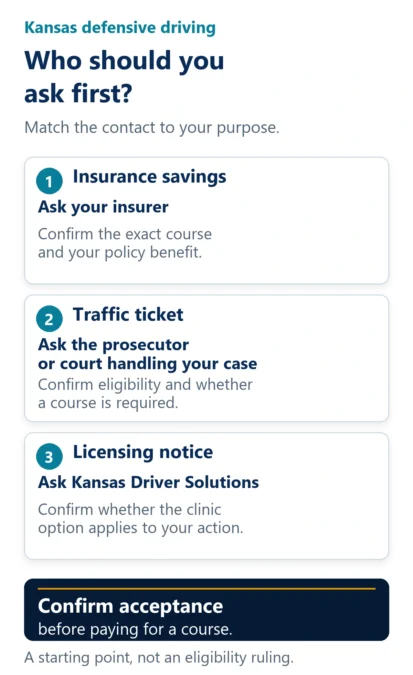
| Your reason for taking a class | What completion may accomplish | Start here |
|---|---|---|
| You want a voluntary insurance benefit | A qualifying course establishes eligibility for the statutory reduction on specified coverages, subject to the law’s conditions | Your insurer or insurance agent |
| You received a traffic ticket | A class may be a condition of an approved local diversion or another direction in your case; dismissal depends on satisfying the applicable terms | The prosecutor or court handling that citation |
| Your license is at risk after repeated moving violations | The Division may permit eligible attendance at a driver-improvement clinic to retain driving privileges | Kansas Driver Solutions / Division of Vehicles |
| You already have an order requiring a course | The accepted class addresses that requirement; the order and applicable process determine the remaining steps | The office that issued the order |
The insurance rule comes from K.S.A. 40-1112a. The licensing clinic provision is K.S.A. 8-255(f). Johnson County’s traffic-diversion documents illustrate the separate local case process. 1 3 7
Insurance savings: a four-hour minimum and a three-year benefit
Kansas law requires an appropriate premium reduction on liability, personal injury protection, and collision coverages after the covered vehicle’s principal operator successfully completes a qualifying motor vehicle accident-avoidance course. The course must last at least four hours and use either a nationally recognized driver-training curriculum or one approved by a state or federal agency. 1
The required reduction lasts for three years after successful completion. K.S.A. 40-1112a does not set a minimum age or a fixed discount percentage. It allows only one premium reduction for the principal operator of a covered vehicle under this provision. 1
That gives you a concrete question for your insurer: Which course meets the requirements for my policy, and what dollar reduction would apply? The Kansas Department of Insurance directs consumers to ask their insurer about accepted courses and the discount amount. 4
Age and percentage claims need careful reading
Some course pages advertise “55 and older.” That threshold is not in K.S.A. 40-1112a. Ask whether it describes a particular product or insurer offer. 1
Likewise, the required reduction is not a promise that your entire premium will fall by a particular percentage. The statute names three coverages and leaves the amount as an appropriate reduction. Ask for the expected savings on those coverages in dollars, plus the date the insurer would apply them. 1
A useful way to compare the cost is to subtract the complete course charge from the insurer’s projected savings over the period you expect to keep that policy. Treat that as your own estimate. A quoted reduction does not establish what future renewal premiums will be.
The reason for attendance can change eligibility
The statutory insurance benefit does not apply when the approved course is specified by an administrative order of the director of vehicles or by a court order as a result of a moving traffic violation. A required course and a voluntary insurance course can therefore have different legal effects, even when their subject matter sounds similar. 1
If your class relates to diversion, probation, or a licensing action, give your insurer the actual paperwork. Ask whether the statutory exclusion applies to the way your course was assigned. A provider’s assurance that a certificate is “good for insurance” does not settle that question.
You should also ask whether the insurer offers a separate voluntary benefit if the statutory reduction does not apply. Do not count on one until the insurer confirms it for your attendance reason and policy.
Driving after the course still matters
The insurer may condition providing and maintaining the reduction on the principal operator having no at-fault accident and no more than one moving-violation conviction during the three years after completion. That does not mean every moving violation automatically ends the benefit, or that a not-at-fault accident does. 1
The course organization must issue a certificate that can be used to qualify for the reduction. Successful completion of another approved course every three years is required to continue eligibility. 1
Before paying, ask your insurer to confirm:
- The exact course name and provider it accepts.
- Whether it accepts the proposed online or classroom format.
- Whether you are the principal operator whose completion would qualify the vehicle.
- Which coverages receive the reduction and its estimated dollar amount.
- How to submit the certificate and confirm that the reduction was applied.
- Any driving-record conditions it uses under the statute.
Save the response with your certificate. That gives you something specific to refer to if the policy paperwork does not show the expected benefit.
A ticket requires the local case process
A course does not create a statewide entitlement to ticket dismissal. For county or district attorney diversion, K.S.A. 22-2908 sets decision factors and prohibitions; the local program determines the application and case terms. Check the court named on your citation rather than choosing a program solely because it is nearby. 2
Johnson County’s District Attorney describes traffic diversion as an opportunity for dismissal after compliance with the agreement. Its February 2026 policy distinguishes a three-month diversion term from a six-month formal diversion term. Its agreement says some charges require a class or specified documentation, rather than requiring the same defensive-driving class for every applicant. 6 7
For that program, the office instructs applicants choosing diversion not to pay the ordinary fine and court costs on the ticket; they pay the amounts established through diversion instead. The policy also says to continue court appearances until the agreement is filed and the court date is cancelled. 5 6
Wichita Municipal Court publishes a different process, including an application deadline of 30 days after citation issuance and a $25 nonrefundable application fee. Those are Wichita requirements, not statewide course-enrollment rules. 8
These examples explain why a class advertised for “Kansas tickets” is only a possible product. Your case still needs an approved route and instructions about whether a class belongs in it.
Get the course requirement in writing
Ask the handling office whether you are eligible for its program, whether any class is required, and whether it accepts the exact provider and format you are considering. Then identify three separate deadlines: applying for the program, completing any required course, and delivering proof. One date should not stand in for all three.
Your agreement may also contain conditions beyond attendance. Read those terms before committing to the process, and ask about any wording you do not understand. Johnson County’s published agreement, for example, includes conditions about keeping a valid license, insurance, and registration, as well as obeying traffic laws throughout the term. 7
Keep a copy of the agreement, the certificate, and the proof-submission confirmation. After meeting the conditions, ask how to confirm the final case disposition. A completed class, a submitted certificate, and a dismissed charge are three different events.
Repeated moving violations: ask Driver Solutions about the clinic provision
Kansas’s licensing statute authorizes the Division of Vehicles to restrict, suspend, or revoke driving privileges when a person has been convicted of three or more moving traffic violations committed on separate occasions within a 12-month period. Other grounds for licensing action also appear in K.S.A. 8-255. 3
Subsection (f) gives the Division a discretionary clinic option for a person whose driving privileges are subject to suspension under that specific three-violation provision. After reviewing the driving record, the Division may permit the person to retain driving privileges by attending a driver-improvement clinic. 3
That is a licensing decision made by the Division. The statute does not describe a general purchase-a-course point credit or say that attending any retail defensive-driving class erases prior convictions.
The clinic provision calls for application to the Division with the required fee. It excludes people issued a commercial driver’s license from that attendance application. It authorizes a clinic fee of no more than $500, but that ceiling does not establish a current enrollment charge or the availability of a particular class. 3
If you receive a licensing notice, ask Driver Solutions whether the clinic provision applies to your action, what process is currently available, and which clinic and fee the Division accepts. Follow the notice’s instructions and any directions you receive through the process. Confirm the clinic and fee with Driver Solutions before paying anyone.
Kansas Driver Solutions publishes contacts, a license-status tool, and a way to order a driving record. Use those official resources to clarify your action and confirm your status; a completion certificate alone is not proof that driving privileges were retained or restored. 9
What counts as an approved option?
Approval needs to match the benefit. For insurance, the statutory curriculum and minimum-duration requirements matter, and the insurer can identify accepted courses. For a case requirement, the handling office must accept the course. For the licensing clinic option, the Division makes the relevant decision. 1 4 3
An “approved” label alone does not tell you which of these purposes a course serves. A provider may offer several products with different hours or formats. Confirm the product name, not just the company name.
Use this comparison after you know which options the relevant office accepts:
| Check | What to record |
|---|---|
| Exact product | Provider, course name, hours, and delivery format |
| Acceptance | Who confirmed it and which policy, case, or licensing purpose the confirmation covers |
| Complete cost | Enrollment charge plus any required certificate, delivery, or other charge disclosed by the provider |
| Completion logistics | Test requirements, access period, and when the certificate becomes available |
| Proof delivery | Who receives the certificate and whether you or the provider sends it |
| Refund terms | What the provider will do if you bought the wrong course or acceptance is refused |
For an insurance course, the four-hour minimum is a statutory requirement. A longer course is not automatically better for your purpose, and an attractive advertised price does not establish acceptance. 1
For a case or licensing requirement, get the hours and format from the handling office’s directions. Do not substitute the insurance minimum for a different assignment. Compare providers only after you have confirmed which exact courses are accepted for your situation.
Commercial license holders need a separate eligibility check
Kansas law bars a county or district attorney from entering diversion on a Chapter 8 violation when the defendant held a CDL at the time of the violation or at any subsequent time before diversion consideration. That timing matters; acquiring a CDL after the ticket can still fall within the prohibition. 2
Johnson County’s policy also excludes CDL holders regardless of whether they were driving a commercial vehicle when the offense occurred. Wichita’s published traffic-diversion eligibility excludes CDL holders as well. 6 8
The licensing clinic application has its own CDL exclusion. These restrictions concern case eligibility and the licensing clinic; they do not prohibit CDL holders from taking driving-safety training generally. The separate insurance statute has no age or CDL condition. 3 1
Tell the handling office that you hold or have held a commercial license before buying a class for a ticket benefit.
Finish the process by checking the result
For insurance, submit the certificate as the insurer directs, then ask for confirmation of the reduction, the affected coverages, and the benefit period. If it is missing, follow up with the course details and the earlier acceptance response.
For a court or prosecutor requirement, deliver proof by the case deadline, keep confirmation, and complete the rest of the agreement. Ask the handling office how and when to confirm dismissal or the other promised disposition. Johnson County’s policy cautions that a dismissed charge could still appear on a criminal-history record; dismissal is not a promise that every record disappears. 6
For a licensing matter, follow the Division’s instructions and confirm your driving privileges through Driver Solutions. Keep the certificate and correspondence together rather than treating attendance as permission to drive. 9 3
Your next step is to get the exact accepted course in writing from the office that controls the outcome. Then compare cost, format, and certificate delivery among the options that actually fit your policy or case.
Related Reading
- Traffic school rules by state
- How course insurance discounts work
- Insurance costs after a traffic ticket
Sources
- Kansas Office of Revisor of Statutes, K.S.A. 40-1112a(a)-(e): motor vehicle insurance reduction, qualifying course, duration, conditions, certificate, ordered-course exclusion, and renewal.
- Kansas Office of Revisor of Statutes, K.S.A. 22-2908(a) and (b)(2): county/district attorney diversion factors and commercial-license prohibition.
- Kansas Office of Revisor of Statutes, K.S.A. 8-255(a)(2) and (f): conviction-based licensing action and discretionary driver-improvement clinics.
- Kansas Department of Insurance, Consumer Connection: Ask about defensive driver discounts: insurer confirmation of accepted courses and benefit amount.
- Johnson County District Attorney, Traffic Diversion: program entry and payment directions.
- Johnson County District Attorney, Traffic Diversion Policy, revised February 2026: local terms, court appearances, CDL exclusion, and record caution.
- Johnson County District Attorney, Terms of Traffic Diversion Agreement, revised September 2025: agreement conditions and class/documentation requirement for some charges.
- Wichita Municipal Court, Traffic Diversion: local application deadline, application fee, and CDL exclusion.
- Kansas Department of Revenue, Suspended Licenses / Driver Solutions: official contacts, license-status check, and driving-record resources.
Last updated: October 8, 2026