

Texas Defensive Driving Insurance Discount: What to Ask Your Insurer
Texas insurance and course rules checked: September 3, 2026

A Texas defensive driving insurance discount may lower your premium, but Texas does not require every auto insurer to offer one. The state also sets no universal percentage, age requirement, or discount period. Your insurance company’s filed rating rules control the actual benefit.
That makes the order of operations important. Ask your insurer about the exact course and savings before you enroll. A course advertised as “Texas approved” may be suitable for a court dismissal, but that does not prove that your insurer will apply a voluntary discount to your policy.
Quick answer: Texas insurers often offer discounts for completing a defensive-driving or driver-education course, but each company sets its own terms. Confirm the accepted course, eligible driver and vehicle, percentage or dollar savings, affected coverages, proof process, effective date, expiration or renewal rule, and any disqualifying events before paying.
General information only: This guide explains the current statewide framework. It does not quote your insurer’s rate filing, your policy, or a court order. Get the insurer’s answer in writing and follow the court’s separate instructions if you are taking a course for ticket dismissal.
Texas Has Three Different Insurance Results
People often use “insurance benefit” to describe three different results. Keeping them separate prevents the most expensive misunderstanding in this process.
| Result | What creates it? | What it does |
|---|---|---|
| Voluntary course discount | The insurer’s own filed discount rule | May reduce eligible premium charges under the insurer’s terms |
| Protection for course completion | Article 45A.357(b)(1) | Prevents cancellation or a premium increase because you completed a driving safety or motorcycle operator training course |
| Protection after dismissal | Article 45A.357(a) and (b)(2) | Keeps a qualifying dismissed charge off the driving record and prevents cancellation or a premium increase because of that dismissal |
The voluntary discount rewards completion under the insurer’s rules. The completion protection applies even if a charge is not ultimately dismissed. The separate dismissal protection depends on a qualifying dismissal under the Texas driving-safety procedure. None of these results automatically proves another.
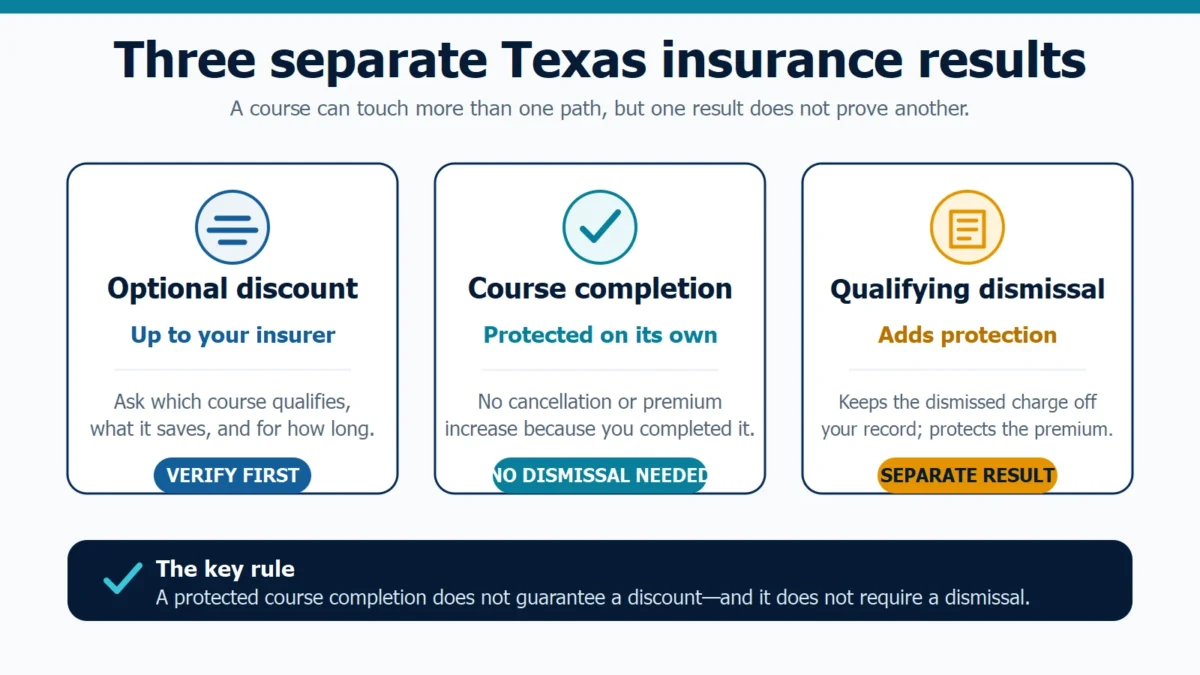
The optional discount, protection for course completion, and protection after a qualifying dismissal are separate results.
For national context on the first path, read how traffic-school insurance discounts work.
Does Texas Require a Defensive Driving Discount?
No. In a February 11, 2025 consumer warning, the Texas Department of Insurance addressed ads that imply Texas requires a discount based on your age, your car’s age, or your driving habits.
“Insurance companies may offer discounts, but no state law or rule mandates discounts or puts a time limit on them. Such claims are misleading.” — Commissioner Cassie Brown
TDI’s current auto-insurance FAQ gives the practical rule: companies often offer a discount for a defensive-driving or driver-education course, and each company sets its own terms. Its auto-insurance guide likewise says each company decides which discounts to offer and how much they are worth.
“Companies often offer discounts for completing a defensive driving or driver education course. Each company sets its own discount terms.” — TDI auto-insurance FAQ
This means there is no reliable statewide answer to questions such as:
- Is the discount 5%, 10%, or 15%?
- Does it last one year or three years?
- Must the driver be 55 or older?
- Does an online course qualify?
- Does the percentage apply to the whole premium?
- Can every driver on a household policy claim it?
Any of those terms may appear in a particular company’s rule. None should be presented as the Texas rule without evidence from the insurer that writes your policy.
What Your Insurer Controls
“Each company decides what discounts to offer and the amount of the discount.” — TDI auto-insurance guide
Texas recognizes defensive-driver discounts in its insurance data system, but recognition is not a mandate. The Texas Private Passenger Auto Statistical Plan, effective January 1, 2026, defines the field as “a discount if the principal operator has completed a defensive driver course.” Pages E-31 and E-45 then distinguish three reporting results: “Discount is offered and the risk qualifies,” offered but not qualified, or “Discount is not offered for the coverage.”
That three-way structure matches the consumer guidance. Before comparing course prices, ask the insurer to resolve each part of the policy decision.
The exact course
Ask which course the company accepts. A Texas Department of Licensing and Regulation (TDLR)-approved driving safety course? A driver-education course? A mature-driver program? Something else? “Defensive driving” is also a marketing label, so get the exact accepted course type.
If the insurer requires a state-approved driving safety course, verify the provider through the current TDLR Driving Safety Provider Search. Approval alone does not establish insurance eligibility; it only confirms the provider’s current status in the state system.
“This directory is provided for the sole purpose of verifying the license status of driver education providers regulated by TDLR. Inclusion is not an endorsement.”
The eligible driver and vehicle
Ask whether the person completing the course must be the principal operator of the vehicle. The statistical-plan field uses that relationship, but the insurer’s current filed rule controls the policy decision.
This matters on multi-driver and multi-car policies. A qualifying driver may be assigned to one vehicle, and a discount tied to that risk may not reduce every charge on the household bill.
The amount and coverage base
Do not multiply an advertised percentage by the entire policy premium. Ask which coverage charges receive the reduction and request both the percentage and the estimated dollar change for your actual policy term.
An insurer could apply a percentage to selected base premiums rather than to taxes, fees, optional services, every vehicle, or every coverage. The declarations page and written quote should show whether the result is meaningful.
The effective date
Ask whether the credit begins when you finish the course, when the insurer receives the certificate, at the next renewal, or on another date allowed by its rule. Texas does not impose a single statewide timing rule for this optional discount.
The duration and renewal rule
Do not assume the benefit lasts three years because that is common in another state or appears on a provider’s website. TDI says Texas law does not put a time limit on auto-insurance discounts. The insurer must tell you how long its discount lasts, whether you must retake the course, and how early a renewal course may be completed.
Events that can end eligibility
Ask whether a ticket, at-fault accident, claim, lapse, driver reassignment, vehicle change, or policy rewrite can remove the credit. Also ask whether the company will notify you when the discount expires.
A Ticket-Dismissal Course Is a Separate Decision
Texas justice and municipal courts may allow an eligible driver to complete an approved driving safety course for dismissal. That process is controlled by the court and Chapter 45A of the Code of Criminal Procedure, not by the insurer’s voluntary discount rule.
Article 45A.357 provides two protections, and only one depends on a dismissal:
- Dismissal protection: A charge dismissed under the subchapter may not be part of your driving record or used for any purpose. An insurer also may not cancel your policy or increase your premium because of that dismissal.
- Course-completion protection: An insurer may not cancel your policy or increase your premium because you completed a driving safety course or motorcycle operator training course. The statute connects the completion and dismissal grounds with or, so this protection does not require a completed dismissal.
An insurer “may not cancel or increase the premium charged an insured under the policy because the insured” completed a covered course or received a qualifying dismissal.
This is stronger and more precise than saying “defensive driving keeps insurance from going up.” The statute protects against an increase because of either course completion or a qualifying dismissal. It does not freeze the total premium. A renewal price may still change because of a broad rate revision, a different driver or vehicle, claims, coverage choices, location, mileage, credit-based insurance scoring where permitted, or another lawful rating factor.
If the dismissal falls through, the course-completion protection still applies. What you lose is the separate protection tied to the dismissal: an unresolved or convicted charge may be handled under the ordinary record and rating rules. Buying or finishing a course without court approval does not create a dismissal, and missing the court’s deadline or proof requirements can lead to a different disposition.
If your immediate goal is citation dismissal, follow the court process first. Use the related Texas guides below for the separate court, eligibility, and provider checks.
Can the Same Course Produce All Three Results?
Possibly, but never assume it. Article 45A.357 protects course completion and a qualifying dismissal as separate grounds. It does not order the insurer to add a voluntary discount.
An insurer might accept the same course certificate under its discount rule. It might require a different course purpose, a clean-record condition, a certain driver assignment, or a certificate submitted through its own channel. Only the insurer can confirm that policy-level result.
Use this two-call check:
- Ask the court whether the course is authorized for the citation and what must be filed for dismissal.
- Ask the insurer whether that exact course and attendance reason qualify for a separate premium discount.
Keep the answers in separate notes. A provider cannot approve the court outcome or bind the insurer.
Questions to Ask Before You Enroll
Use your policy number and the exact course name when you call or message the insurer.
- Do you currently offer a defensive-driver discount on my Texas auto policy?
- Which exact course type, provider approval, and delivery format do you accept?
- May the course be taken for court dismissal, or must it be voluntary for insurance purposes?
- Which driver and vehicle qualify?
- Does age or driving history affect eligibility?
- Which coverage charges receive the reduction?
- What percentage applies, and what is the estimated dollar savings for this policy term?
- When does the discount begin?
- What certificate, receipt, or other proof must I submit, and through which channel?
- How long does the discount last, and is a repeat course required?
- What event could end the discount early?
- Will the insurer send a revised declarations page or endorsement?
Ask the representative to send the answer through the insurer’s secure message center or email. If the first representative cannot identify the rule, ask for underwriting or rating support rather than relying on a guess.
How to Claim the Discount
1. Confirm the benefit in writing
Get the course, eligibility, amount, coverage base, and timing before spending money. A percentage without an eligible-premium base is not enough to calculate savings.
2. Verify the provider and course
Match the insurer’s required course to an authoritative provider list. If TDLR approval is required, confirm the current license record immediately before enrollment. Save a dated copy or screenshot of the result.
3. Complete the exact course
Use the name and delivery format the insurer approved. Save the enrollment confirmation, receipt, completion date, and certificate. If the course also serves a court case, preserve a separate copy for the court.
4. Send proof to the insurer
Follow the insurer’s submission instructions. A provider’s report to TDLR, DPS, or a court does not prove the certificate reached the insurance company.
5. Check the policy document
Review the revised declarations page, endorsement, or renewal offer. Confirm the correct driver, vehicle, amount, effective date, and expiration date. Follow up promptly if the written result differs from the quote.
6. Compare the net benefit
Subtract the course price from the insurer’s projected savings and account for your time. If the reduction is small or short-lived, other policy changes or comparison shopping may matter more. See ways to lower your car insurance for a broader checklist.
A Simple Savings Example
Suppose an insurer confirms that $1,000 of a driver’s six-month premium is eligible for a 5% defensive-driver credit. The projected savings would be $50 for that term:
$1,000 × 0.05 = $50
If the full six-month bill is $1,600, multiplying 5% by $1,600 would produce the wrong estimate unless the insurer says every charge is eligible. This example explains the calculation only. It is not a Texas average, a typical discount, or a promise from any company.
For the most useful comparison, ask the insurer for the premium with and without the course credit while holding the drivers, vehicles, coverages, limits, and deductibles constant.
When to Wait Before Buying a Course
Pause if any of these are true:
- The insurer has not confirmed that it offers the discount.
- You are relying on a provider’s “up to” percentage.
- The insurer has not named the accepted course or format.
- You do not know which driver, vehicle, or coverage charges qualify.
- You are assuming a court-dismissal course automatically creates the discount.
- The provider cannot be found in the approval system the insurer requires.
- The projected savings are smaller than the cost and time involved.
- You need legal guidance about a citation and have not contacted the court or a qualified attorney.
If an advertisement claims that Texas law guarantees a discount or creates an urgent deadline, compare it with TDI’s warning. TDI accepts complaints about misleading insurance advertising. Its Help Line is 800-252-3439, weekdays from 8 a.m. to 5 p.m. Central.
Texas Defensive Driving Insurance Discount FAQs
Does defensive driving lower insurance in Texas?
It can. TDI says companies often offer discounts for completing a defensive-driving or driver-education course, but each company sets its own terms. Confirm the benefit before enrolling.
Is there a required Texas defensive driving discount percentage?
No. Texas sets no universal defensive-driving percentage. Ask for the percentage, the eligible coverage base, and the dollar change on your own policy.
Does Texas require a discount for drivers age 55 or older?
No statewide law or rule mandates an auto-insurance discount based on age. Your own insurer may still offer a mature-driver or defensive-driver discount. Ask what its rules are.
How long does a Texas defensive driving discount last?
There is no statewide duration. The insurer determines the term, renewal requirements, and events that may end its optional discount.
Will an online course qualify?
Only if it satisfies the insurer’s rule. Confirm the exact provider, course, and delivery format. TDLR approval may be required, but approval by itself does not bind the insurer.
Can my insurer raise my rate after I complete a course?
Article 45A.357 says an insurer may not cancel or increase the premium because you completed the course, even if the dismissal later falls through. It separately protects a charge dismissed under the subchapter. Neither rule prevents a price change caused by other lawful rating factors.
Do I need to send the certificate to my insurance company?
Follow the insurer’s instructions. Do not assume a report sent to a court or state agency also reaches the insurer. Save proof of your submission and check the next policy document.
Verify the Dollar Benefit, Not the Headline
The Texas rule is straightforward once the three results are separated. The discount is up to your insurer. Texas does not require one. Course completion has its own protection against cancellation or a premium increase for that reason, even without a dismissal. A qualifying dismissal adds separate record and premium protections, but it does not guarantee an extra discount or freeze the entire policy price.
Before enrolling, get a written answer tied to the exact course and your actual policy. The useful number is the insurer’s estimated dollar change—not an unsupported statewide percentage.
Related Reading
- How traffic-school insurance discounts work
- Ways to lower your car insurance
- Texas driving safety course: ticket dismissal and court steps
- Texas defensive-driving ticket dismissal rules
- Texas TDLR-approved driving safety courses compared
Sources
- Texas Department of Insurance — Companies may offer auto insurance discounts; no law requires discounts
- Texas Department of Insurance — Auto insurance FAQ
- Texas Department of Insurance — Auto insurance guide
- Texas Department of Insurance — Texas Private Passenger Auto Statistical Plan, effective January 1, 2026
- Texas Code of Criminal Procedure — Chapter 45A, including Article 45A.357
- Justia — Article 45A.357 verifying text, accessed September 3, 2026
- Texas Department of Licensing and Regulation — Driving Safety Provider Search
- Texas Department of Insurance — Search home and auto insurance rate filings
Last updated: September 3, 2026