

New York PIRP Insurance Discount: Eligibility and Duration
Last reviewed: August 30, 2026

The New York PIRP insurance discount can lower eligible parts of an auto insurance premium for three years. It does not automatically take 10% off the entire bill.
The course completer generally must be the vehicle's principal operator, and the certificate must reach the insurer or agent on time. This guide helps you check the vehicle, coverage lines, and dates before estimating the benefit.
General information only: This article explains New York's statewide framework. It is not legal or insurance advice. Your insurer applies its filed rating rules to your drivers, vehicles, coverages, and policy dates.
New York PIRP Insurance Discount: Quick Answer
| Question | Current New York rule |
|---|---|
| What is the reduction? | An actuarially appropriate reduction; DFS guidance describes at least 10% of named eligible base rates—not 10% of the total premium |
| Which coverages are named? | Liability, No-Fault, and collision |
| How long does it last? | Three years after qualifying course completion |
| Who must complete the course? | The principal operator of the insured vehicle |
| When should the certificate be submitted? | As soon as it is available and preferably within 90 days after completion |
| What if it arrives after 90 days? | The insurer may apply the reduction from the presentation date instead of the completion date |
New York DMV summarizes the benefit on its Point and Insurance Reduction Program page. The governing statute is New York Insurance Law § 2336.
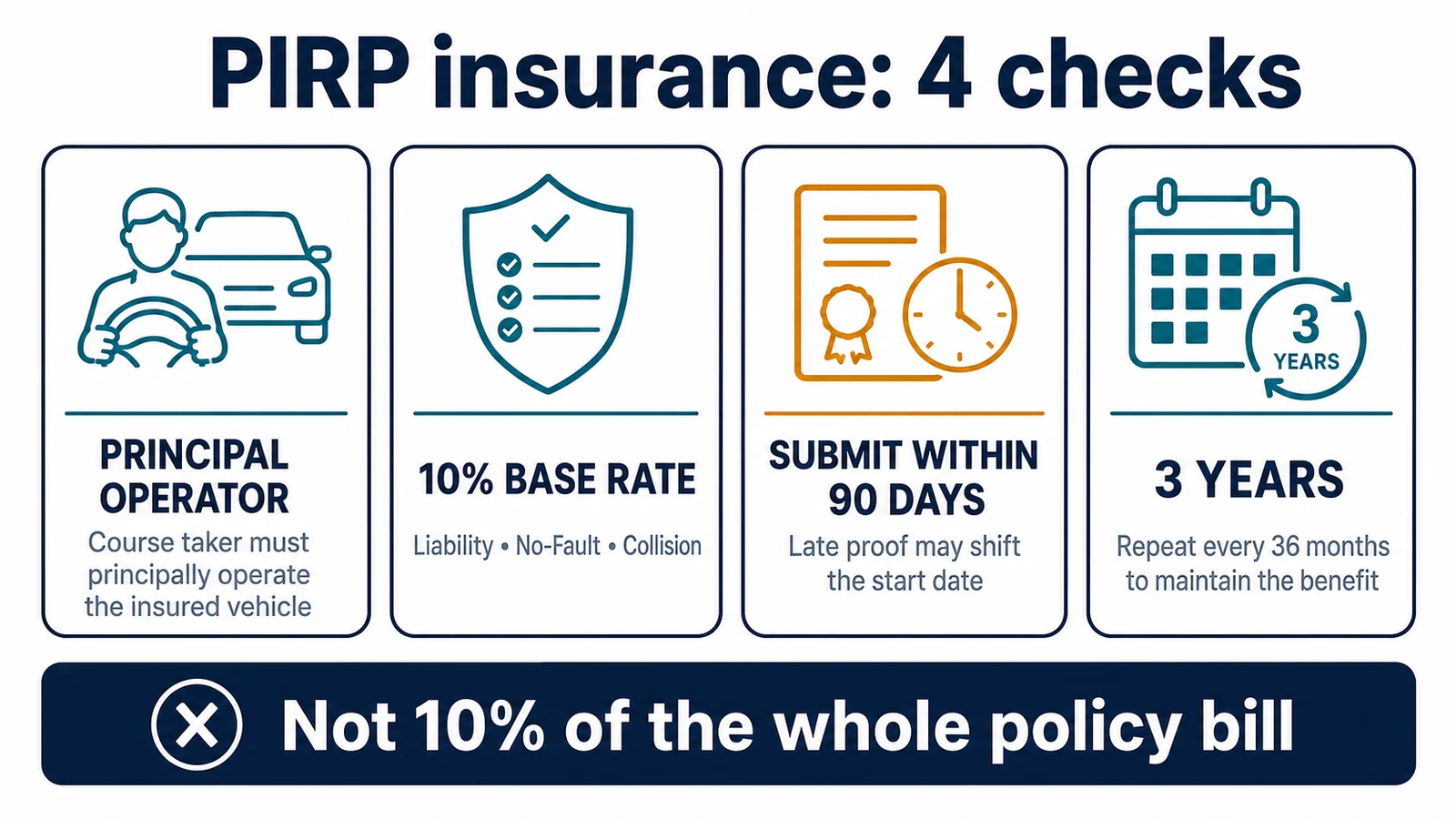
The 10% Does Not Apply to the Entire Insurance Bill
The most important calculation boundary is the phrase base rate.
Insurance Law § 2336(a) requires an actuarially appropriate reduction for liability and collision premiums for three years, but it does not state a percentage. DFS Circular Letter No. 1 directs insurers to apply at least 10% to the liability base rate. An insurer may file to apply the reduction percentage to the actual class rate. A sponsor's advertising is narrower: 15 NYCRR § 138.13(a)(18)(i) permits a 10% claim.
A total bill can also contain comprehensive coverage, fees, endorsements, and charges outside the PIRP calculation.
That means this shortcut can be wrong:
Total six-month bill × 10% = expected PIRP savings
The bill may mix eligible and ineligible charges.
What “base rate” means here
New York DFS Circular Letter No. 1 starts with the adult pleasure-use rate for private-passenger liability. The insurer adjusts it for purchased limits and applicable discounts, then calculates it before merit-rating surcharges.
That amount can differ from the final premium shown for a coverage. Ask the insurer to identify the applicable base-rate components instead of reverse-engineering them from the bill.
Which Coverages Are Named, and by What
The official sources use different language for the coverage list:
- Insurance Law § 2336(a) names liability and collision, requires an actuarially appropriate reduction, and sets the three-year term. It does not set a percentage.
- DFS Circular Letter No. 1 directs at least 10% off the liability base rate. Liability includes No-Fault/PIP, bodily injury, and property damage. The letter treats collision as an optional, more generous extension.
- 15 NYCRR § 138.13(a)(18)(i) permits sponsor advertising of 10% for three years on liability, No-Fault, and collision base rates. § 138.13(a)(18)(iv), however, refers only to liability and collision when discussing repeat courses.
- DMV's consumer page describes the base-rate benefit for auto and motorcycle insurance, while its 90-day explanation mentions liability and collision. DFS's consumer page names liability, collision, and No-Fault.
Treat liability, No-Fault, and collision as the working list. Ask the insurer to identify each line—especially collision—under its filed plan.
Coverage checklist
Ask the insurer to show how PIRP affects each line:
| Policy component | PIRP treatment to confirm |
|---|---|
| Bodily injury liability | Included within the liability framework |
| Property damage liability | Included within the liability framework |
| No-Fault / personal injury protection | Included |
| Collision | Named in § 2336(a) and § 138.13(a)(18)(i); treated as an optional extension in Circular Letter No. 1. Confirm this line explicitly. |
| Comprehensive | Not named as a PIRP coverage; do not assume it receives the reduction |
Best practice: Ask for the dollar amount, vehicle, and coverages receiving the reduction. That is more reliable than multiplying the whole premium by 10%.
Principal Operator Status Controls Eligibility
New York DMV says the reduction applies to the principal operator of the insured vehicle. DFS guidance likewise says the reduction applies when the certificate holder is the principal operator. No source reviewed defines that phrase for every household arrangement, so confirm the insurer's assignment before enrolling.
Multi-driver household example
Suppose your policy lists two adults and two cars. You are the principal operator of Car 1. The other adult is the principal operator of Car 2.
- If only you complete PIRP, ask whether the reduction applies only to Car 1.
- If an occasional driver completes PIRP, do not assume that certificate changes either car's rate.
- If the assignments are unclear or recently changed, confirm them before paying for the course.
Do not change a principal-operator designation merely to seek a discount. The policy should accurately identify how the vehicles are actually used.
Youthful and assigned-risk drivers
DMV says youthful and assigned-risk drivers can receive the benefit when they are the principal operator and complete an approved course. Ask whether a youthful driver's separate driver-education reduction can also apply; do not assume the two stack.
Motorcycles and other vehicles
DMV describes the base-rate benefit for auto and motorcycle insurance. DFS also addresses motor homes, assigned risks, and some commercial vehicles.
Those policies can use different rating structures. Ask the insurer to confirm a clearly defined principal operator, the eligible vehicle and coverages, and the filed calculation. Do not carry over a private-passenger estimate.
Only an Approved PIRP Course Qualifies
Vehicle and Traffic Law § 399-c requires the commissioner to approve an accident-prevention course before it qualifies for the mandatory insurance reduction. Classroom and approved Internet or alternate-delivery courses can qualify; current New York DMV approval of the exact course is what matters.
DFS OGC Opinion 05-12-09 concluded that an out-of-state National Safety Council course that was not DMV-approved did not qualify. It also rejected self-instruction as a substitute for the approved course.
Before enrolling:
- Open the New York DMV approved PIRP sponsor list.
- Find the exact sponsor under the relevant classroom or online section.
- Confirm that the course being sold is the approved New York PIRP course.
- Ask how and when the completion certificate will be delivered. On its online-course page, DMV says, “You must contact the insurance company and supply your certificate to them.”
- Confirm with the insurer that you are the principal operator of the vehicle expected to receive the reduction.
For the overall course decision—including formats, point rules, and approval checks—use the New York PIRP course guide. This insurance page does not compare sponsors or course prices.
Warning: A generic defensive-driving, driver-education, court, or employer course is not automatically a New York PIRP course. Approval attaches to the exact program, not just the phrase “defensive driving.”
Certificate Timing Can Change the Effective Date
Keep four dates separate:
- the course completion date;
- the certificate issue or receipt date;
- the date the certificate is presented to the insurer or agent; and
- the policy renewal date.
New York Insurance Law § 2336(d) calculates the reduction from the completion date, then allows two departures: the insurer may use the presentation date when proof arrives more than 90 days later, or start at renewal when proof arrives during the preceding 45 days. DMV explains how timely submission preserves the completion-date treatment.
Certificate presented within 90 days after completion
New York DMV says that when the certificate is presented within 90 days, the liability and collision reduction begins immediately and is retroactive to the course-completion date.
If the reduction begins during an existing policy period, § 2336(d) says it is prorated over that policy term. DFS guidance also explains that an insurer can credit a certification-date amount at the next renewal rather than issue a midterm return premium.
The billing may appear as a revised installment, account credit, renewal credit, or another documented adjustment. Ask the insurer which method it used.
Certificate presented within 45 days before renewal
If the certificate is presented during the 45 days before renewal, § 2336(d) permits the insurer to begin the reduction on the first day of the new policy period for the full statutory term.
This is an insurer election. Record the presentation and renewal dates, then ask which start date it selected.
Certificate presented more than 90 days after completion
When proof arrives more than 90 days after completion, the insurer may apply the reduction from the date the certificate was presented rather than the completion date.
Late submission can cost part of the benefit period; it does not create a new completion date.
Practical rule: Submit the certificate as soon as you receive it. Do not wait for renewal unless the insurer gives you a documented reason to do so.
Use This Certificate-Timing Worksheet
Complete this worksheet before calling the insurer.
| Item | Your information | Why it matters |
|---|---|---|
| Course sponsor and exact course | Must be currently DMV approved | |
| Completion date | Starts the statutory timing analysis | |
| Certificate received date | Shows whether delivery caused delay | |
| Certificate presented date | Controls the 90-day and 45-day questions | |
| Next renewal date | Determines whether the near-renewal election may apply | |
| Vehicle where you are the principal operator | Identifies the likely eligible vehicle | |
| Liability base-rate amount | Ask insurer | One named part of the calculation |
| No-Fault base-rate amount | Ask insurer | One named part of the calculation |
| Collision base-rate amount | Ask insurer | One named part of the calculation |
| Effective date confirmed by insurer | Prevents assumptions based on billing appearance | |
| Three-year expiration date | Sets the renewal-course reminder |
Save your certificate, submission confirmation, revised declarations page, and any message identifying the effective date. These records will help you correct an error later.
What the Three-Year Duration Means
The benefit lasts three years. DMV says drivers must take PIRP once every 36 months to maintain it.
Do not expect an early repeat course to enlarge the insurance benefit. § 138.13(a)(18)(iv) prohibits sponsors from advertising that taking the course more often than once every three years improves the 10% liability-and-collision reduction.
Set a reminder before expiration, then ask the insurer when it wants the renewal certificate.
If you change insurers
DFS Circular Letter No. 1 says the remaining period can continue after a new insurer receives and verifies the certificate. The original three-year period does not restart.
When switching carriers, provide the certificate and completion date. Confirm the covered vehicle, coverage lines, remaining expiration date, and the reduction shown on the new declarations page.
PIRP Does Not Cancel Other Premium Changes
New York DMV expressly states that PIRP does not prevent general premium increases or increases caused by violations or crashes.
The PIRP reduction and an insurer surcharge are separate calculations. A policy can receive the PIRP reduction and still cost more at renewal because of a conviction, crash, territory change, vehicle change, coverage change, or broader rate revision.
For the nationwide context, see how defensive-driving insurance discounts work; state approval and insurer rules still control the actual benefit.
Likewise, PIRP's DMV point treatment does not change an insurer's separate rating or “point” system. For the license calculation, see the New York PIRP point-reduction guide.
PIRP also does not:
- remove the Driver Responsibility Assessment when the underlying convictions or points trigger it;
- prevent a mandatory suspension or revocation; or
- erase convictions or points from the driving record.
Those record consequences follow separate rules. The broader guide to how long points stay on a driving record explains why the DMV count, the visible record, and an insurer's review can follow different timelines.
When comparing bills, ask the insurer to separate PIRP from violation or crash surcharges, coverage changes, driver or vehicle changes, and general rate revisions.
DFS Circular Letter No. 1 says the insurer shall indicate the reduction on the rating information, declarations page, premium bill, or another appropriate notice. If you cannot find it, ask the insurer to identify the line and dollar amount.
Common New York PIRP Insurance Mistakes
- Multiplying the entire bill by 10%: Use only the base-rate lines the insurer confirms.
- Matching every driver to every vehicle: The certificate holder's principal-operator assignment matters.
- Waiting more than 90 days: Submit proof promptly and keep delivery evidence.
- Expecting PIRP to block a surcharge: Review the reduction and any increase separately.
- Repeating early for a larger benefit: DMV uses a 36-month maintenance cycle.
- Buying from an unapproved seller: Verify the exact sponsor, course, and format before paying.
Frequently Asked Questions
Is the New York defensive driving insurance discount really 10%?
DFS guidance describes at least 10% on the liability base rate, while sponsor advertising rules permit a 10% claim for liability, No-Fault, and collision base rates. Insurance Law § 2336(a) itself sets no percentage. Ask the insurer to identify the filed calculation and covered lines.
Does the reduction apply to comprehensive coverage?
Comprehensive is not part of the PIRP reduction described in § 2336(a). Section 2336(e) is a different rule. It gives a comprehensive-coverage reduction for approved anti-theft or recovery devices. Do not count that benefit as PIRP.
Can I qualify without points or a traffic ticket?
Yes. The insurance benefit does not require an active point balance. Course completion still affects the separate once-in-18-months point-reduction eligibility, so consider both clocks before enrolling.
Does an online New York PIRP course qualify?
Yes, if the exact Internet or alternate-delivery course is currently approved by New York DMV. For online completion, DMV says the sponsor mails a physical certificate and an emailed copy is not valid for the insurance claim.
I took defensive driving in another state—does it count?
Not unless the exact course is approved by New York DMV for PIRP. A generic defensive-driving course, an out-of-state course, or self-instruction does not qualify merely because the material is similar.
Can PIRP keep my premium from increasing after a ticket?
No. PIRP does not prevent a violation surcharge or a general rate increase. It supplies a separate reduction to eligible base-rate components.
The Bottom Line
The New York PIRP insurance discount is valuable when the approved course, principal operator, vehicle, coverage lines, and dates line up. The statute requires an actuarially appropriate reduction for three years; DFS guidance describes at least 10% on named base-rate coverages. It is not automatically 10% of the entire bill.
Confirm principal-operator status before enrolling. After completion, submit the certificate promptly, record the effective date, and check the policy documents for the actual applied amount. That turns a broad “10% discount” promise into a benefit you can verify.
Related Reading
- New York PIRP course: benefits, rules, and approval checks
- How New York PIRP point reduction works
- How defensive-driving insurance discounts work
- How long points stay on your license
- Does traffic school remove a ticket from your record?
Sources
- New York DMV — Point and Insurance Reduction Program
- New York DMV — Approved Point and Insurance Reduction Program Courses
- New York DMV — Online and Alternative Delivery Method Courses
- New York Insurance Law § 2336
- New York Vehicle and Traffic Law § 399-c
- New York DMV — Commissioner's Regulations Part 138
- New York DFS — Circular Letter No. 1 (1980)
- New York DFS — Second Amendment to Circular Letter No. 1 (1981) — does not alter the base-rate, percentage, or coverage guidance used above
- New York DFS — OGC Opinion 05-12-09, Accident Prevention Course Discount
- New York DFS — Auto Insurance Discounts and Saving Money
Last updated: August 30, 2026.


