
Massachusetts Defensive Driving Course: What a Course Can and Cannot Do
A Massachusetts defensive driving course can meet an RMV order to retrain. It does not turn a civil traffic ticket into a dismissal. If a notice says you could lose your right to drive, start with the class it names. Then check what else you must do before you can drive again.
The state counts certain crashes and traffic offenses when it takes action against a license. Insurance points serve a different purpose. A course sold as “point reduction” may leave you with the wrong class and an open RMV notice. The main duty to retrain comes from M.G.L. c. 175, § 113B.
This guide helps you match the course to your notice, plan around the deadline and check the result. It also explains why a class cannot solve every ticket, license or rate problem.
Last reviewed: September 30, 2026. This is general guidance, not legal advice about your case.
Quick answer
- Three surchargeable incidents can trigger an order to take the Driver Retraining Program, or DRP.
- Follow both the legal deadline and the course’s rules for when to finish.
- A civil ticket, a junior license and a habitual-offender notice have different rules.
- Taking the class does not promise a clean record or a lower insurance bill.
Start here: Choose why you need a course.
Choose why you need a course
Read the reason on your notice before you shop for a class. Start with the row that matches it. If you have two notices, check both.
| Your situation | What a course can do | Your next step |
|---|---|---|
| RMV notice for three surchargeable incidents | Meet the order to retrain | Use the RMV-linked NSC route and the dates on your notice |
| Suspension for seven qualifying incidents | A class does not replace this separate suspension | Check this notice apart from any course notice |
| A new civil traffic ticket | A course is not a dismissal option under the civil hearing rule | Read the ticket’s payment and hearing instructions |
| Junior operator or learner’s permit suspension | Named programs may be part of the steps you must take | Check each step for your license or permit type |
| Habitual traffic offender revocation | An approved course is one step toward getting a license back | Follow the RMV hearing and license rules |
| A higher insurance bill | Do not assume the RMV course will lower your rate | Ask your insurer which plan and discounts apply |
The legal routes come from M.G.L. c. 175, § 113B, c. 90, § 20, c. 90, § 22F and c. 90C, § 3. Insurers can use their own filed merit plans in a competitive market. Ask which plan sets your rate. 211 CMR 134.08(1)
Do not pay yet if you are unsure which class to take
Pause before you pay when:
- A court order names a class, but you are looking at a generic online course.
- You have several notices and cannot match each one to a class.
- You hold a commercial license and need to check its separate rules.
- You have moved out of state and need a route the RMV will accept.
- A site promises points off or a discount without checking your case.
Contact the agency or court named on your notice. Keep it beside you when you call. Give the exact name and date on the notice, then ask which class meets that order. A similar course name is not enough to show that you have found the right one.
When Massachusetts requires driver retraining
The main rule starts when the Merit Rating Board reports three surchargeable incidents in the past 24 months. After a hearing limited to whether the board’s records are correct, the registrar must order a driver education program that meets the registrar’s standards. You cannot choose this route just to erase a ticket. M.G.L. c. 175, § 113B
“Surchargeable incidents” is the term in the law. It does not mean every police stop or just three tickets. Check the events on your notice. If a listed event is wrong, follow the RMV’s steps to raise that issue at the hearing about the board’s records.
The RMV directs you to the National Safety Council, or NSC, for DRP. NSC tells the RMV when you finish. The RMV handles your license status; NSC runs the course. A different course seller cannot decide that you have met the RMV order. RMV course guidance
What if the NSC packet has not arrived?
The RMV says you should get an NSC packet within ten days after you get the suspension notice. If it does not arrive, contact NSC. Keep working from the notice’s dates while you seek help. Do not set it aside just because the packet is late. RMV: Three surchargeable events
Have your notice and license details ready. If you have already signed up, keep that record handy too. Ask which class you still need and how to book it. Save the reply with the notice, so you can refer to the same details if you need to call again.
Follow both the legal deadline and the course instructions
The law gives you 90 days after the registrar mails the notice to send proof that you finished the course. If that proof does not reach the registrar in time, your license or right to drive must be suspended until it does. The clock does not start when you buy a class or open the packet. M.G.L. c. 175, § 113B
NSC says to finish at least four business days before the suspension date on your notice. Leave that time for the course and its reporting steps. NSC’s rule does not change the law’s 90-day deadline. Use both when you plan when to take the class. NSC course rules
Put these dates on one calendar:
- The date the notice was mailed and the listed suspension date.
- Your class date or plan for when to finish online.
- The extra time NSC says to leave before the deadline.
- A date to check that the RMV has marked the course done.
For example, a class may have open seats but end too close to your deadline. Before you pay, ask NSC about an earlier class that meets your order. Ask when it will send proof to the RMV. Signing up for a class is not the same as finishing it.
The RMV says finishing on time avoids the further license action named in the three-event notice. That applies to that notice. It does not show that a separate suspension has ended. Keep each notice in view when you check your right to drive. RMV deadline guidance
Can you take the Massachusetts course online?
Take the format assigned to you. The RMV’s course page describes a classroom program. Its linked NSC page says a course may be in person or online. That is not a free choice for every driver. NSC bases the assigned format on how many DRP classes you must take. RMV course page and NSC sign-up page
Check the class name, your name and license details, and the date before you book. If you have several notices, ask which class goes with each. A screen that lets you pay for one class does not prove that it covers every order you have.
What should you check about cost?
Use the price shown for the class you are assigned. Check the total charge and the rules for changing dates before you pay. Save the receipt and sign-up details. A price from a search ad may be for a different course, so this guide does not quote one fixed fee.
If you now live outside the state, NSC has a route for you to follow. It asks for proof of where you live now. Check what NSC will accept before you buy a class near your new home. NSC out-of-state route
Does a course dismiss a Massachusetts traffic ticket?
Not under the civil traffic hearing rule covered here. The court must find you responsible or not responsible. The law does not let it dismiss the case, continue it without a finding or place it on file as another way to end it. A course does not add a dismissal choice. M.G.L. c. 90C, § 3(A)(4)
For a ticket that lists only civil traffic offenses, the law gives you 20 days from the ticket date to pay or ask to contest it. Read the steps on the ticket before you spend time looking for classes. Course shopping does not take care of your duty to respond. M.G.L. c. 90C, § 3(A)(2)
Paying ends the case and counts as a conviction for RMV action and the Safe Driver Insurance Plan, or SDIP. It is not a criminal conviction put in the court’s criminal or probation records. Those are distinct legal effects, even though the same payment is involved. M.G.L. c. 90C, § 3(A)(3)
If your papers also list criminal charges, this civil-ticket guide does not cover your whole case. Follow the court’s steps and get advice that fits those charges.
Can defensive driving remove Massachusetts points?
The state does not use a general license-point balance that DRP can reduce. The license rules here count certain events or convictions. SDIP points relate to insurance rates. Do not treat them as license points that a class can erase. RMV license rules and 211 CMR 134.01(1)
When someone says a ticket added “points,” ask which record they mean:
- Is the RMV counting events toward a license action?
- Is your insurer using SDIP points?
- Does your insurer use its own merit plan?
The answer tells you who to ask next. Proof that you took a class shows that you finished training. It does not tell you whether a ticket is still on your record or how much your next bill will be.
What about an insurance discount?
Ask your insurer before you count on savings. Insurers can use their own filed merit plans in a competitive market. A rule for one type of market cannot tell you what every plan allows. Check which plan applies to your policy. 211 CMR 134.08(1)
The RMV order tells you to retrain. It does not promise a lower rate. Ask your insurer whether it offers a separate course discount, which class it accepts and what proof it needs. Get the terms in writing before you pay for an extra class just to save on your bill.
Other suspension notices need separate attention
Seven incidents is a different rule
The law calls for a 60-day suspension when the count reaches seven in any three-year period, after the hearing about whether the board’s records are correct. It counts the at-fault crashes and moving-violation convictions named in the law. Those include certain ticket payments and alcohol-program assignments. The rule does not offer a class in place of the suspension. M.G.L. c. 175, § 113B
If you also have a three-event course notice, keep both. Ask the RMV what will still be open after the class. Do not merge the two notices into one deadline or assume that doing one task closes both.
Repeated speeding and related convictions
The RMV calls one route “3 speeding tickets.” The law names offenses under sections 16 and 17 and rules made under section 18. It calls for revocation on a third or later conviction in the same twelve-month period, with the offense having taken place in the same year. M.G.L. c. 90, § 20
Under that rule, a new license cannot be issued for at least 30 days. After that, the registrar still decides whether to issue one. Check the basis on your notice. A finished DRP class does not by itself give you the right to drive again.
Junior operators and learner’s permits
For speeding under §§ 17 or 17A, or special speed rules made under § 18, section 20 sets a 90-day first suspension for a learner’s permit or junior operator license (JOL). A later offense carries one year. If you hold a permit, you must apply for one again. M.G.L. c. 90, § 20
A junior operator must finish SCARR, an attitudinal-change program and the driving test the registrar requires before getting the license back. Fees and an added surcharge to restore the license also apply. Make a list from your notice, with a parent or guardian if that helps. Keep each class, test and fee as its own item to check off.
Habitual traffic offenders
A habitual traffic offender revocation has its own rules for which convictions count. The usual path back to a license includes a four-year revocation, an approved course and the competence exam the registrar requires. You may ask for a hardship hearing after one year. The registrar can grant or deny that limited license. M.G.L. c. 90, § 22F
A course alone does not end the loss of your license. Work from the RMV’s finding and hearing steps. Do not count every crash or ticket yourself: the law defines what counts and has an exception that can group some convictions together.
After the course: check the record, then your status
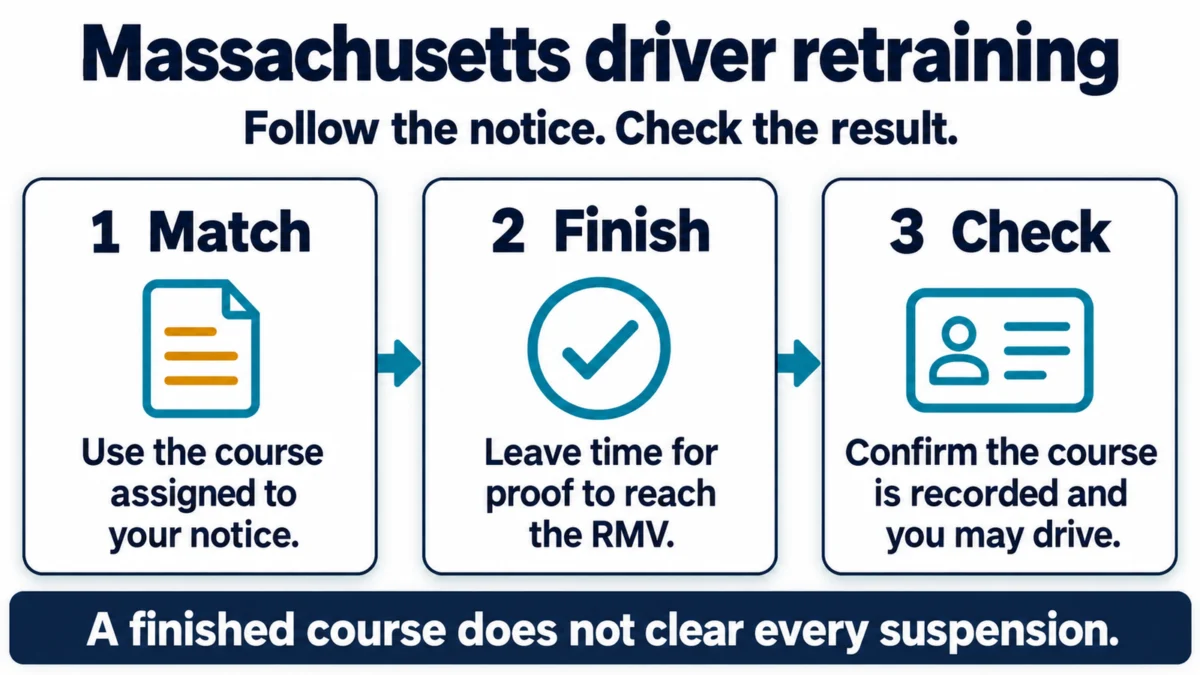
Keep proof that you finished and check that the RMV has marked the right course done. NSC reports to the RMV, but the legal duty is for proof to reach the registrar. Your receipt helps if you need to follow up. It does not replace a check of your right to drive. RMV reporting guidance and M.G.L. c. 175, § 113B
Use this checklist:
- Save the sign-up record and proof that you finished.
- Match the class you took to the order on your notice.
- Check with the RMV that the record is correct.
- Look at each other notice for tasks you still need to do.
- If you were suspended, check your right to drive before you drive again.
Be clear when you ask for help: “Does my record show this course is done?” Then ask, “Is there any other reason I still cannot drive?” These questions help separate a class that is done from a license that is valid.
Frequently asked questions
Can I pay the ticket and take a course later to erase it?
Do not count on that. Payment counts as a conviction for RMV and SDIP purposes under the civil-ticket rule. A later order to retrain serves a different purpose. Check what paying means before you act on a course seller’s claim. M.G.L. c. 90C, § 3(A)(3)
What if I get several notices to retrain?
Keep each one and ask RMV or NSC which class goes with it. Do not assume one class covers them all. Start with the earliest open date when you ask for help, and keep notes so you can track each notice on its own.
Does signing up stop the suspension?
The law calls for proof that you finished within the stated time. Booking a seat does not meet that rule. If the next class is too late, contact NSC and the RMV promptly about your notice. M.G.L. c. 175, § 113B
Will the class lower my premium?
Do not assume it will. Your insurer’s filed plan matters. Ask whether it offers a discount for the exact course you plan to take, and get the terms before you pay. 211 CMR 134.08(1)
Match the course to the notice
A Massachusetts defensive driving course helps when it meets the order you have. Read the notice, check the assigned class, finish with time for reporting, and check the result with the RMV. Keep the class record and your license status as two things to confirm.
For a three-event notice, start with the RMV’s course steps. For a different notice, follow the route it names. This helps you spend your time and money on the task that moves your case forward.
Related Reading
- How defensive driving courses work
- Compare traffic-school rules across states
- Why license points and insurance consequences differ
- Review practical ways to lower your premium
- Understand what a speeding ticket can cost
Sources
- M.G.L. c. 175, § 113B: three-incident retraining, proof deadline and separate seven-incident suspension.
- M.G.L. c. 90, § 20: repeated-conviction and junior-operator provisions.
- M.G.L. c. 90, § 22F: habitual traffic offender rules and reinstatement conditions.
- M.G.L. c. 90C, § 3: civil-ticket response, payment and hearing outcomes.
- 211 CMR 134: Insurance scope and insurer-filed merit plans, especially 134.01(1) and 134.08(1). The calculation rules in 134.10 are required only in a fixed-and-established market; they are not used here to rule out every insurer’s course discount.
- RMV: Suspensions from multiple offenses: notices, NSC enrollment route and completion reporting.
- RMV: Required classes and programs: distinct retraining and reinstatement programs.
- NSC: Massachusetts Driver Retraining Program: assigned delivery formats, completion instructions and out-of-state route. Program operations only; not the authority for legal effects.
Last updated: September 30, 2026.